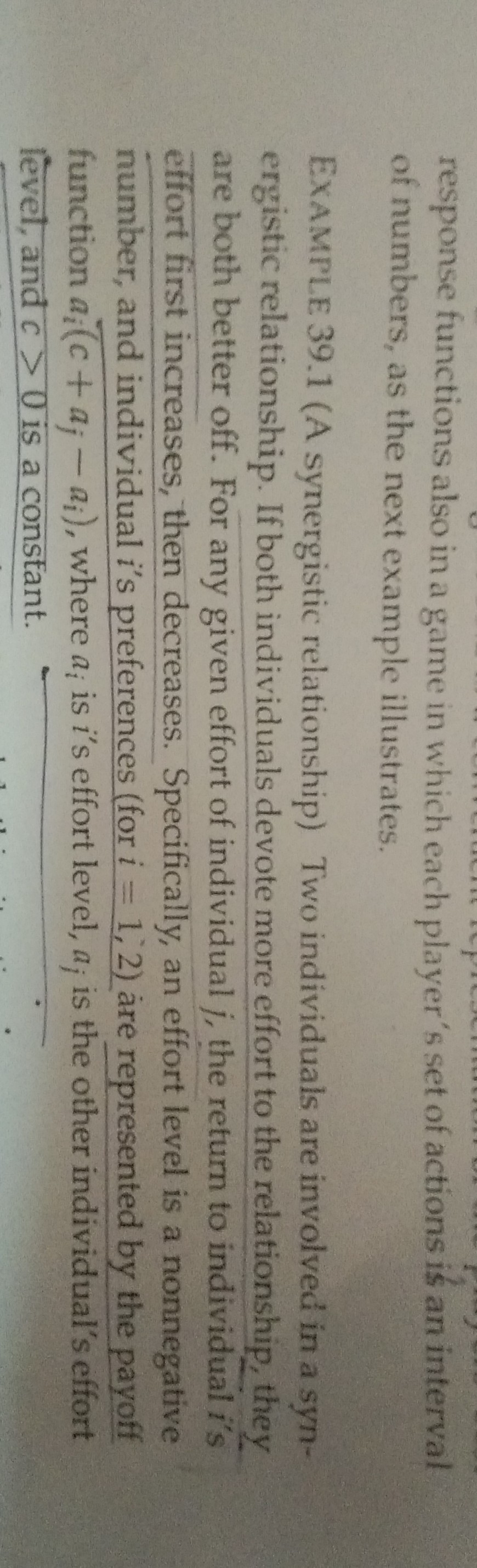
response functions also in a game in which each player's set of actions is an interval of numbers, as the next example illustrates.
EXAMPLE 39.1 (A synergistic relationship) Two individuals are involved in a synergistic relationship. If both individuals devote more effort to the relationship, they are both better off. For any given effort of individual \( j \), the return to individual \( i \) 's effort first increases, then decreases. Specifically, an effort level is a nonnegative number, and individual \( i^{\prime} \) s preferences (for \( i=1,2 \) ) are represented by the payoff function \( a_{i}\left(c+a_{j}-a_{i}\right) \), where \( a_{i} \) is \( i^{\prime} \) 's effort level, \( a_{j} \) is the other individual's effort level, and \( c>0 \) is a constant.