Ace - AI Tutor
Ask Our Educators
Textbooks
My Library
Flashcards
Scribe - AI Notes
Notes & Exams
Download App
lauren morgan

lauren m.

Divider

Questions asked

BEST MATCH

The heel bone is called the ______. tarsus calcaneus not here talus

View Answer
divider
BEST MATCH

What are supervised methods of business analytics? What are unsupervised methods of business analytics? Supervised Methods: Supervised methods are like having a teacher guiding you with specific examples. In these methods, the model is trained on data where the correct answers are already known. For instance, if you’re trying to predict whether a customer will buy a product, you’d train the model using data where you already know which customers bought the product and which didn’t. Unsupervised Methods: Unsupervised methods are like exploring a new area without a map. Here, the model looks for patterns and groupings in data without any pre-defined categories or outcomes. For example, it might group customers based on their buying habits without knowing beforehand what these groups might look like. This method helps to uncover hidden patterns and relationships in the data. Please give a reply to this response.

View Answer
divider
BEST MATCH

Tina has learned that dark clouds predict rain in the near future. This suggests that associative learning involves generalization. cognitive processes. mirror neurons. genetic predispositions.

View Answer
divider
BEST MATCH

zero. (a) The value of grad f * vec(i) at P. positive negative zero (b) The value of grad f * vec(j) at P. positive negative zero (c) (∂f)/(∂x) at Q. positive negative zero (d) (∂f)/(∂y) at Q. zero. (a) The value of f at P. positive negative zero (b) The value of ∇f at P. positive negative zero (c) ∂f/∂x at Q. positive negative zero

View Answer
divider
BEST MATCH

6. List all partial fractions for the expression - calculating constants, (x-1)²(x+2)(x²-4) without

View Answer
divider
BEST MATCH

7. Given the following functions, answer the questions that follow: (i) $y = (4 - x)^5 + 11$ (ii) $y = -2(6 + 3x)^4 + 8$ a. For both functions (i) and (ii), find the stationary values) b. For both functions (i) and (ii), use the Nth derivative test to determine if the stationary value(s) is a relative maximum, relative minimum, or an inflection point.

View Answer
divider
BEST MATCH

The mean finish time for a yearly amateur auto race was 105.35 minutes with a standard deviation of 0.314 minute. The winning car, driven by Ron, finished in 184.37 minutes. The previous year's race had a mean finishing time of 111.3 with a standard deviation of 0.121 minute. The winning car that year, driven by Jane, finished in 110.97 minutes. Find their respective z-scores. Who had the more convincing victory? Ron had a finish time with a z-score of Jane had a finish time with a z-score of (Round to two decimal places as needed.) Which driver had a more convincing victory? A. Jane a more convincing victory because of a higher z-score B. Ron had a more convincing victory because of a lower z-score C. Jane a more convincing victory because of a lower z-score D. Ron had a more convincing victory because of a higher z-score

View Answer
divider
BEST MATCH

Differentiate the given series expansion of $f$ term-by-term to obtain the corresponding series expansion for the derivative of $f$. If $f(x) = \frac{x^7}{1 - x} = \sum_{n=0}^{\infty} x^{7 + n}$ $f'(x) = \sum_{n=0}^{\infty}$

View Answer
divider
BEST MATCH

100 < Dc Beta < 300 RB5 15k? RC3 11.9k? V14 12V RB6 1k? GND Fig 9A: Q1 PROB 9A) Determine the value of the collector voltage Vc. What region of operation is transistor Q1???

View Answer
divider
BEST MATCH

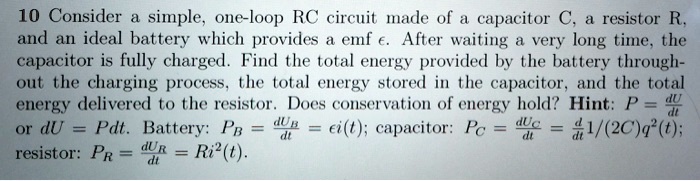
10 Consider a simple, one-loop RC circuit made of a capacitor C, a resistor R, and an ideal battery which provides a emf \( \epsilon \). After waiting a very long time, the capacitor is fully charged. Find the total energy provided by the battery throughout the charging process, the total energy stored in the capacitor, and the total energy delivered to the resistor. Does conservation of energy hold? Hint: \( P = \frac{dU}{dt} \) or \( dU = Pdt \). Battery: \( P_B = \frac{dU_B}{dt} = \epsilon i(t) \); capacitor: \( P_C = \frac{dU_C}{dt} = \frac{d}{dt}\frac{1}{2C}q^2(t) \); resistor: \( P_R = \frac{dU_R}{dt} = Ri^2(t) \).
View Answer
divider