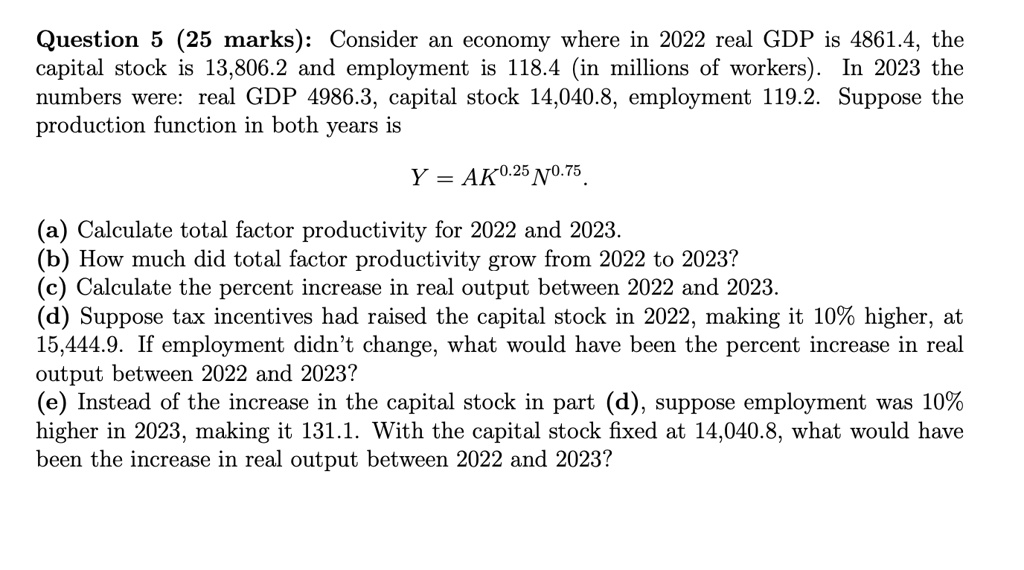
Question 5 (25 marks): Consider an economy where in 2022 real GDP is 4861.4, the
capital stock is 13,806.2 and employment is 118.4 (in millions of workers). In 2023 the
numbers were: real GDP 4986.3, capital stock 14,040.8, employment 119.2. Suppose the
production function in both years is
$Y = AK^{0.25}N^{0.75}$
(a) Calculate total factor productivity for 2022 and 2023.
(b) How much did total factor productivity grow from 2022 to 2023?
(c) Calculate the percent increase in real output between 2022 and 2023.
(d) Suppose tax incentives had raised the capital stock in 2022, making it 10% higher, at
15,444.9. If employment didn't change, what would have been the percent increase in real
output between 2022 and 2023?
(e) Instead of the increase in the capital stock in part (d), suppose employment was 10%
higher in 2023, making it 131.1. With the capital stock fixed at 14,040.8, what would have
been the increase in real output between 2022 and 2023?