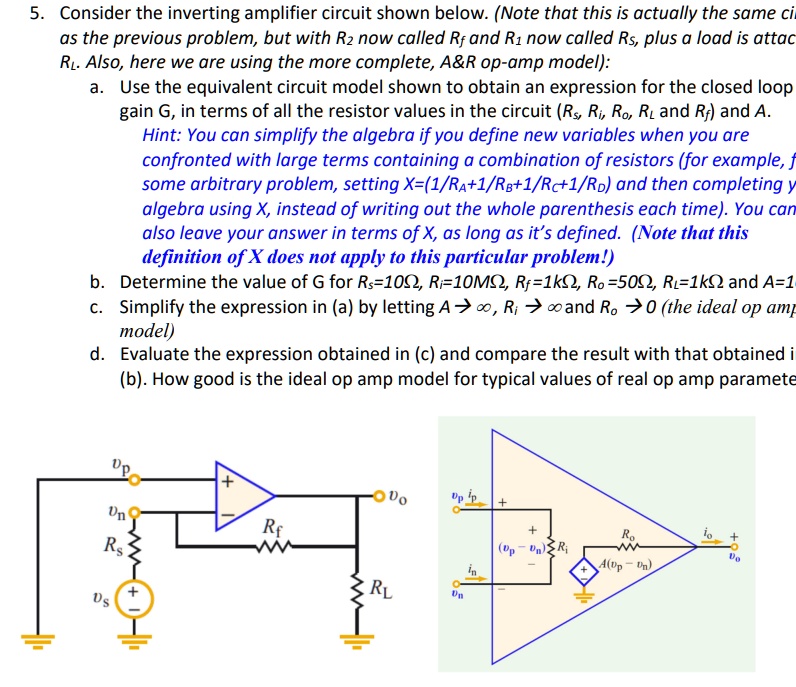
5. Consider the inverting amplifier circuit shown below. (Note that this is actually the same circuit as the previous problem, but with R2 now called Rf and R1 now called Rs, plus a load is attached RL. Also, here we are using the more complete, A&R op-amp model):
a. Use the equivalent circuit model shown to obtain an expression for the closed loop gain G, in terms of all the resistor values in the circuit (Rs, Ri, Ro, RL and Rf) and A.
Hint: You can simplify the algebra if you define new variables when you are confronted with large terms containing a combination of resistors (for example, for some arbitrary problem, setting X=(1/R$_A$+1/R$_B$+1/R$_C$+1/R$_D$) and then completing your algebra using X, instead of writing out the whole parenthesis each time). You can also leave your answer in terms of X, as long as it's defined. (Note that this definition of X does not apply to this particular problem!)
b. Determine the value of G for R$_S$=10?, R$_i$=10M?, R$_f$=1k?, R$_o$=50?, R$_L$=1k? and A=10$^5$
c. Simplify the expression in (a) by letting A? ?, R$_i$? ? and R$_o$? 0 (the ideal op amp model)
d. Evaluate the expression obtained in (c) and compare the result with that obtained in (b). How good is the ideal op amp model for typical values of real op amp parameters?