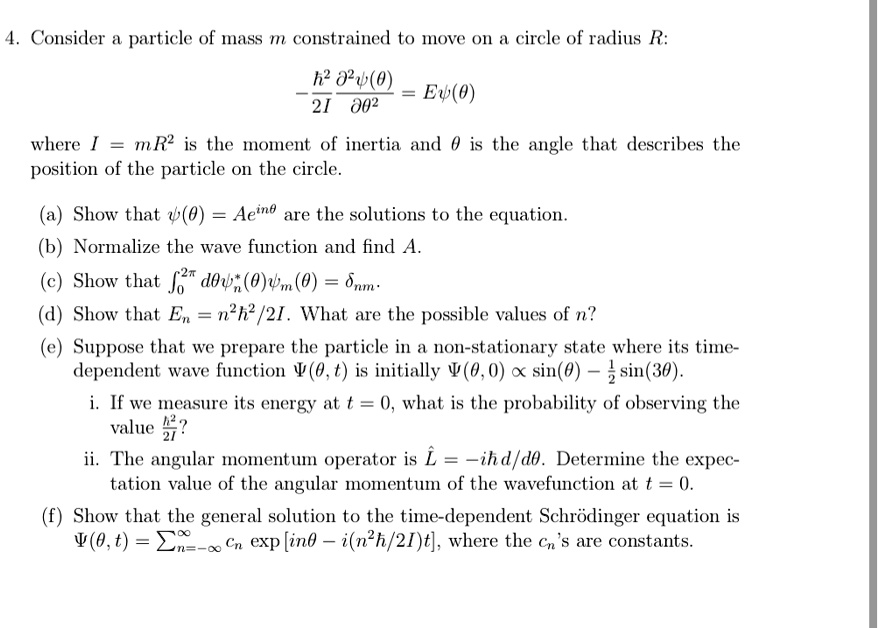
4. Consider a particle of mass m constrained to move on a circle of radius R:
$$-\frac{\hbar^2}{2I}\frac{\partial^2 \psi(\theta)}{\partial \theta^2} = E\psi(\theta)$$
where I = mR² is the moment of inertia and θ is the angle that describes the
position of the particle on the circle.
(a) Show that ψ(θ) = Ae^inθ are the solutions to the equation.
(b) Normalize the wave function and find A.
(c) Show that $$\int_0^{2\pi} d\theta \psi_n^*(\theta)\psi_m(\theta) = \delta_{nm}$$.
(d) Show that E_n = n²ħ²/2I. What are the possible values of n?
(e) Suppose that we prepare the particle in a non-stationary state where its time-
dependent wave function Ψ(θ, t) is initially Ψ(θ, 0) α sin(θ) - 1/2 sin(3θ).
i. If we measure its energy at t = 0, what is the probability of observing the
value ħ²/2I?
ii. The angular momentum operator is L = -iħd/dθ. Determine the expeс-
tation value of the angular momentum of the wavefunction at t = 0.
(f) Show that the general solution to the time-dependent Schrödinger equation is
Ψ(θ, t) = ∑_{n=-∞}^∞ c_n exp[inθ - i(n²ħ/2I)t], where the c_n's are constants.