Figure 1
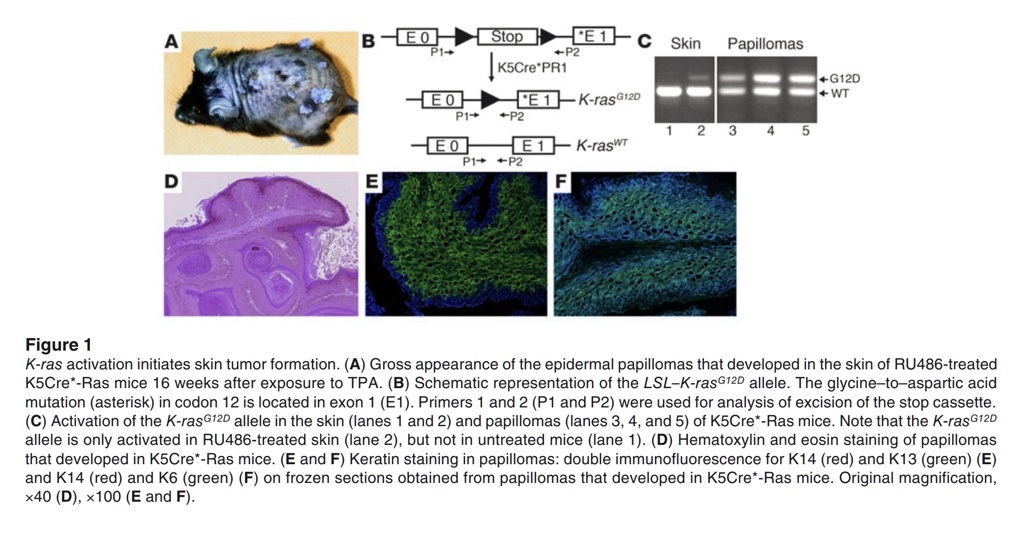
K-ras activation initiates skin tumor formation. (A) Gross appearance of the epidermal papillomas that developed in the skin of RU486-treated
K5Cre*-Ras mice 16 weeks after exposure to TPA. (B) Schematic representation of the LSL-K-rasG12D allele. The glycine-to-aspartic acid
mutation (asterisk) in codon 12 is located in exon 1 (E1). Primers 1 and 2 (P1 and P2) were used for analysis of excision of the stop cassette.
(C) Activation of the K-rasG12D allele in the skin (lanes 1 and 2) and papillomas (lanes 3, 4, and 5) of K5Cre*-Ras mice. Note that the K-rasG12D
allele is only activated in RU486-treated skin (lane 2), but not in untreated mice (lane 1). (D) Hematoxylin and eosin staining of papillomas
that developed in K5Cre*-Ras mice. (E and F) Keratin staining in papillomas: double immunofluorescence for K14 (red) and K13 (green) (E)
and K14 (red) and K6 (green) (F) on frozen sections obtained from papillomas that developed in K5Cre*-Ras mice. Original magnification,
x40 (D), x100 (E and F).