Problem 2: Votes in elections
Suppose that a country has 3 political parties: the Conservative (C), Liberal (L), and National (N) parties. If a person
votes for the candidate from one party in an election, that person may decide to vote for the same party in the next
election or may switch to vote for a candidate from another party in the next election.
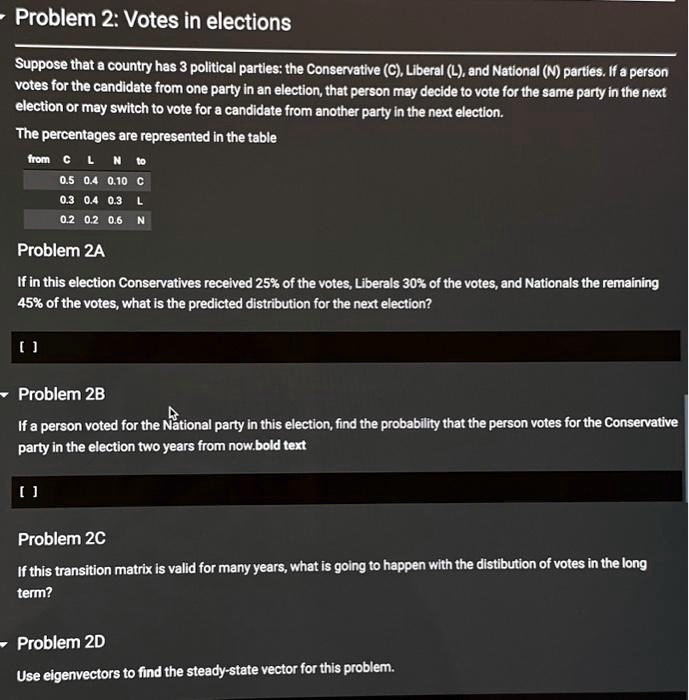
The percentages are represented in the table
from C L N to
0.5 0.4 0.1 0 C
0.3 0.4 0.3 L
0.2 0.2 0.6 N
Problem 2A
If in this election Conservatives received 25% of the votes, Liberals 30% of the votes, and Nationals the remaining
45% of the votes, what is the predicted distribution for the next election?
[]
Problem 2B
If a person voted for the National party in this election, find the probability that the person votes for the Conservative
party in the election two years from now.bold text
[]
Problem 2C
If this transition matrix is valid for many years, what is going to happen with the distibution of votes in the long
term?
Problem 2D
Use eigenvectors to find the steady-state vector for this problem.