There is only one question here; do your best to answer all parts. As usual, this will be graded
based on effort and correctness. Parts (a) and (b) are unrelated.
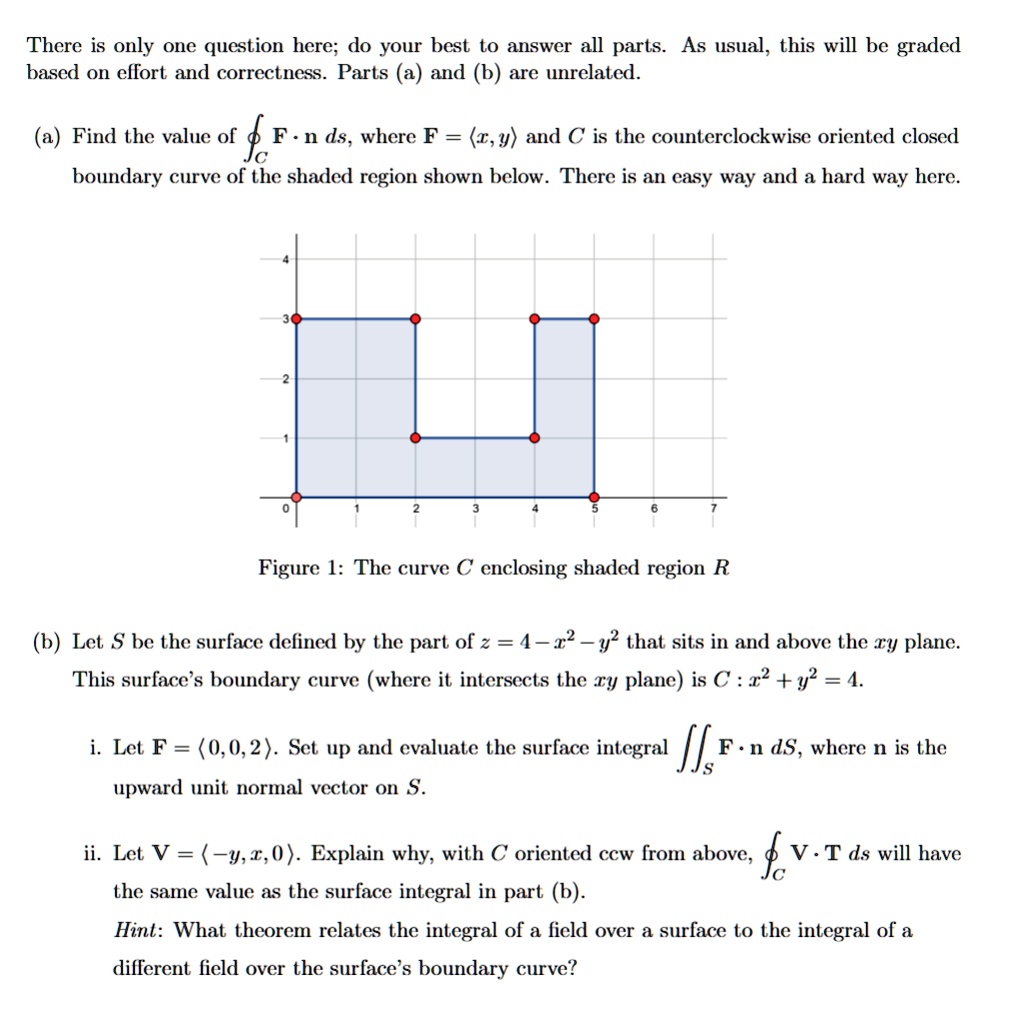
(a) Find the value of $\oint_C \mathbf{F} \cdot \mathbf{n} \, ds$, where $\mathbf{F} = \langle x, y \rangle$ and $C$ is the counterclockwise oriented closed
boundary curve of the shaded region shown below. There is an easy way and a hard way here.
Figure 1: The curve $C$ enclosing shaded region $R$
(b) Let $S$ be the surface defined by the part of $z = 4 - x^2 - y^2$ that sits in and above the $xy$ plane.
This surface's boundary curve (where it intersects the $xy$ plane) is $C: x^2 + y^2 = 4$.
i. Let $\mathbf{F} = \langle 0, 0, 2 \rangle$. Set up and evaluate the surface integral $\iint_S \mathbf{F} \cdot \mathbf{n} \, dS$, where $\mathbf{n}$ is the
upward unit normal vector on $S$.
ii. Let $\mathbf{V} = \langle -y, x, 0 \rangle$. Explain why, with $C$ oriented ccw from above, $\oint_C \mathbf{V} \cdot \mathbf{T} \, ds$ will have
the same value as the surface integral in part (b).
Hint: What theorem relates the integral of a field over a surface to the integral of a
different field over the surface's boundary curve?