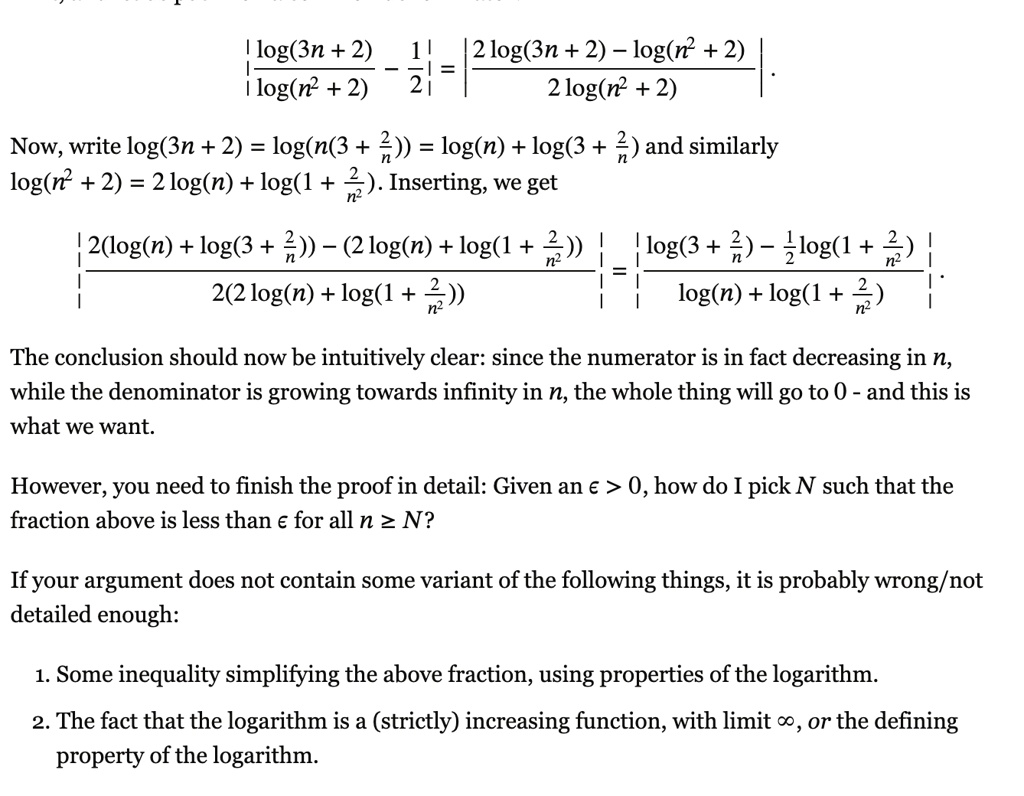
$\frac{|\log(3n+2)|}{|\log(n^2+2)|} - \frac{1}{2} = |\frac{2\log(3n+2) - \log(n^2+2)}{2\log(n^2+2)}|$.
Now, write $\log(3n+2) = \log(n(3+\frac{2}{n})) = \log(n) + \log(3+\frac{2}{n})$ and similarly $\log(n^2+2) = 2\log(n) + \log(1+\frac{2}{n^2})$. Inserting, we get
$|\frac{2(\log(n) + \log(3+\frac{2}{n})) - (2\log(n) + \log(1+\frac{2}{n^2}))}{2(2\log(n) + \log(1+\frac{2}{n^2}))}| = |\frac{\log(3+\frac{2}{n}) - \log(1+\frac{2}{n^2})}{\log(n) + \log(1+\frac{2}{n^2})}|.$
The conclusion should now be intuitively clear: since the numerator is in fact decreasing in n, while the denominator is growing towards infinity in n, the whole thing will go to 0 - and this is what we want.
However, you need to finish the proof in detail: Given an $\epsilon > 0$, how do I pick N such that the fraction above is less than $\epsilon$ for all $n \ge N$?
If your argument does not contain some variant of the following things, it is probably wrong/not detailed enough:
1. Some inequality simplifying the above fraction, using properties of the logarithm.
2. The fact that the logarithm is a (strictly) increasing function, with limit $\infty$, or the defining property of the logarithm.