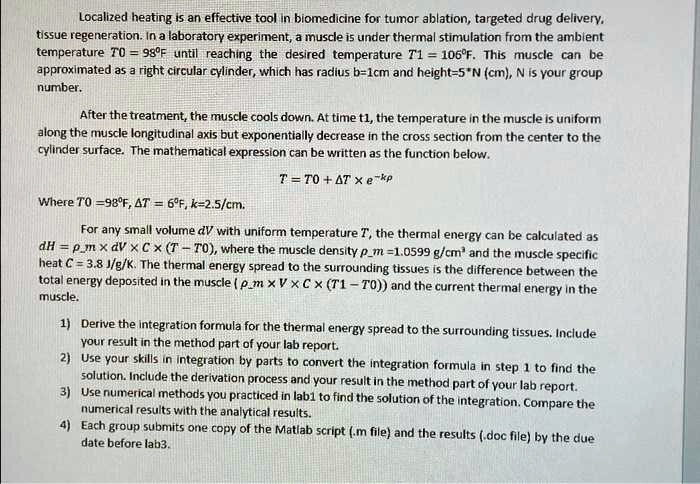
Localized heating is an effective tool in biomedicine for tumor ablation, targeted drug delivery, and tissue regeneration. In a laboratory experiment, a muscle is under thermal stimulation from the ambient temperature T0 = 98°F until reaching the desired temperature T1 = 106°F. This muscle can be approximated as a right circular cylinder, which has a radius b = 1 cm and a height = 5N (cm), where N is your group number.
After the treatment, the muscle cools down. At time t1, the temperature in the muscle is uniform along the muscle's longitudinal axis but exponentially decreases in the cross-section from the center to the cylinder surface. The mathematical expression can be written as the function below:
xV + 0
Where T0 = 98°F, T = 6°F, and k = 2.5/cm. For any small volume aV with a uniform temperature T, the thermal energy can be calculated as dH = p_m * aV * C * (T - T0), where the muscle density p_m = 1.0599 g/cm and the muscle specific heat C = 3.8 J/g/K. The thermal energy spread to the surrounding tissues is the difference between the total energy deposited in the muscle (p_m * V * C * (T1 - T0)) and the current thermal energy in the muscle.
1) Derive the integration formula for the thermal energy spread to the surrounding tissues. Include your result in the method part of your lab report.
2) Use your skills in integration by parts to convert the integration formula in step 1 to find the solution. Include the derivation process and your result in the method part of your lab report.
3) Use numerical methods you practiced in lab 1 to find the solution of the integration. Compare the numerical results with the analytical results.
4) Each group submits one copy of the Matlab script (.m file) and the results (.doc file) by the due date before lab 3.