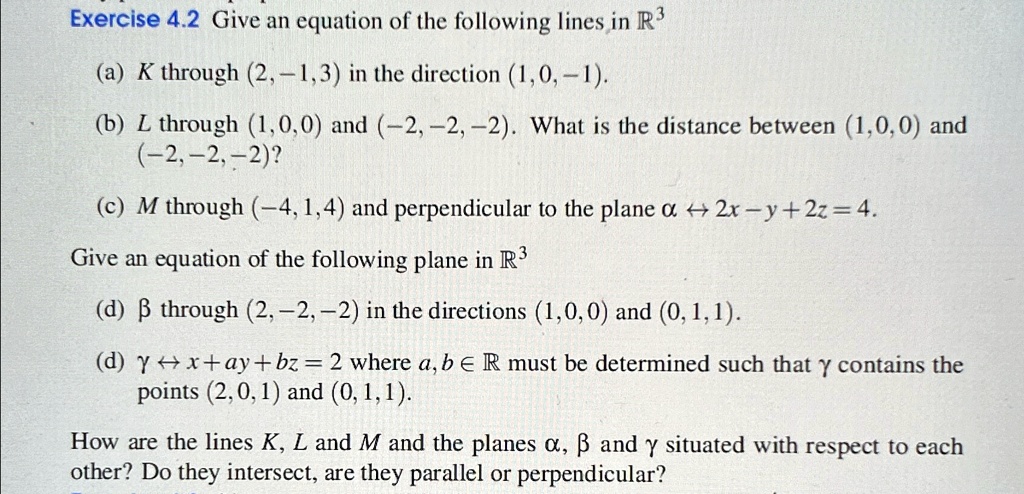
Exercise 4.2 Give an equation of the following lines in \(\mathbb{R}^3\)
(a) K through (2, -1, 3) in the direction (1, 0, -1).
(b) L through (1, 0, 0) and (-2, -2, -2). What is the distance between (1, 0, 0) and
(-2, -2, -2)?
(c) M through (-4, 1, 4) and perpendicular to the plane \(\alpha \leftrightarrow 2x - y + 2z = 4\).
Give an equation of the following plane in \(\mathbb{R}^3\)
(d) \(\beta\) through (2, -2, -2) in the directions (1, 0, 0) and (0, 1, 1).
(d) \(\gamma \leftrightarrow x + ay + bz = 2\) where \(a, b \in \mathbb{R}\) must be determined such that \(\gamma\) contains the
points (2, 0, 1) and (0, 1, 1).
How are the lines K, L and M and the planes \(\alpha\), \(\beta\) and \(\gamma\) situated with respect to each
other? Do they intersect, are they parallel or perpendicular?