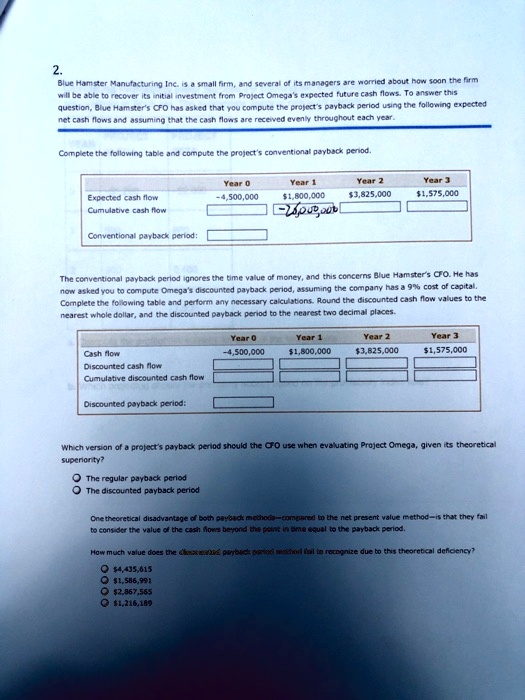
Blue Hamster Manufacturing Inc. is a small firm and several of its managers are worried about how soon the firm will be able to recover its initial investment from Project Omega's expected future cash flows. To answer this, net cash flows are assumed to be received evenly throughout each year. Complete the following table and compute the project's conventional payback period.
Year 0: -4,500,000
Year 1: $1,800,000
Year 2: $3,825,000
Year 3: $1,575,000
Expected cash flow:
Cumulative cash flow:
Conventional payback period:
The conventional payback period ignores the time value of money, and this concerns Blue Hamster's CFO. He has now asked you to compute Omega's discounted payback period, assuming the company has a 9% cost of capital. Complete the following table and perform any necessary calculations. Round the discounted cash flow values to the nearest whole dollar, and the discounted payback period to the nearest two decimal places.
Year 0: -4,500,000
Year 1: $1,800,000
Year 2: $3,825,000
Year 3: $1,575,000
Cash flow:
Discounted cash flow:
Cumulative discounted cash flow:
Discounted payback period:
Which version of a project's payback period should the CFO use when evaluating Project Omega, given its theoretical superiority?
- The regular payback period
- The discounted payback period
One theoretical disadvantage of the net present value method is that it fails to consider the value of the cash flows beyond the payback period.
How much value does the theoretical deficiency have?
$4,435,615
$1,586,991
$2,867,565
$1,216,189