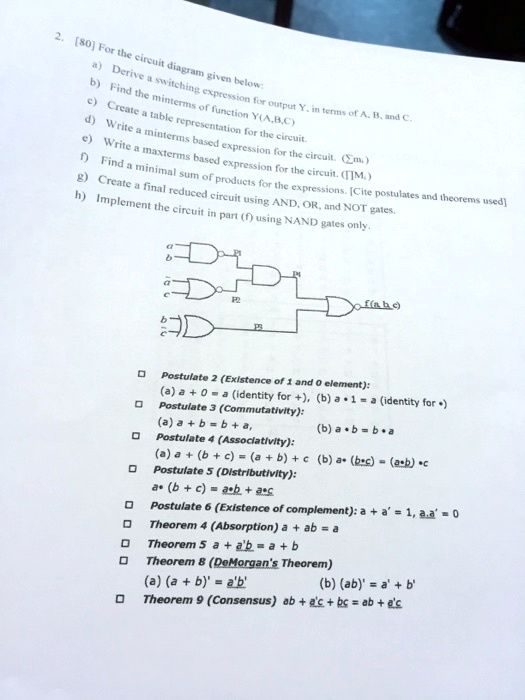
2. [80] For the circuit diagram given below:
a) Derive a switching expression for output Y. in terms of A, B, and C.
b) Find the minterms of function Y(A,B,C)
c) Create a table representation for the circuit.
d) Write a minterms based expression for the circuit. (?m)
e) Write a maxterms based expression for the circuit. (?M)
f) Find a minimal sum of products for the expressions. [Cite postulates and theorems used]
g) Create a final reduced circuit using AND, OR, and NOT gates.
h) Implement the circuit in part (f) using NAND gates only.
Postulate 2 (Existence of 1 and 0 element):
(a) $a + 0 = a$ (identity for +), (b) $a \cdot 1 = a$ (identity for $\cdot$)
Postulate 3 (Commutativity):
(a) $a + b = b + a$,
(b) $a \cdot b = b \cdot a$
Postulate 4 (Associativity):
(a) $a + (b + c) = (a + b) + c$ (b) $a \cdot (b \cdot c) = (a \cdot b) \cdot c$
Postulate 5 (Distributivity):
$a \cdot (b + c) = a \cdot b + a \cdot c$
Postulate 6 (Existence of complement): $a + a' = 1$, $a \cdot a' = 0$
Theorem 4 (Absorption) $a + ab = a$
Theorem 5 $a + a'b = a + b$
Theorem 8 (DeMorgan's Theorem)
(a) $(a + b)' = a'b'$
(b) $(ab)' = a' + b'$
Theorem 9 (Consensus) $ab + a'c + bc = ab + a'c$