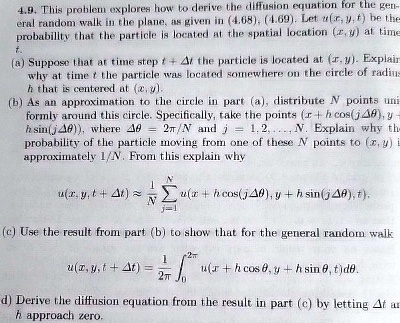
4.9. This problem explores how to derive the diffusion equation for the general random walk in the plane, as given in (4.68), (4.69). Let u(x, y, t) be the probability that the particle is located at the spatial location (x, y) at time t. (a) Suppose that at time step t + ?t the particle is located at (x, y). Explain why at time t the particle was located somewhere on the circle of radius h that is centered at (x, y). (b) As an approximation to the circle in part (a), distribute N points uniformly around this circle. Specifically, take the points (x + h cos(j??), y + h sin(j??)), where ?? = 2?/N and j = 1, 2, ..., N. Explain why the probability of the particle moving from one of these N points to (x, y) is approximately 1/N. From this explain why u(x, y, t + ?t) ? (1/N) ?_{j=1}^{N} u(x + h cos(j??), y + h sin(j??), t). (c) Use the result from part (b) to show that for the general random walk u(x, y, t + ?t) = (1/2?) ?_{0}^{2?} u(x + h cos ?, y + h sin ?, t) d?. (d) Derive the diffusion equation from the result in part (c) by letting ?t and h approach zero.