Ace - AI Tutor
Ask Our Educators
Textbooks
My Library
Flashcards
Scribe - AI Notes
Notes & Exams
Download App
Lily

Lily

Divider

Questions asked

INSTANT ANSWER

Express the series as a rational function. \[ \sum_{n=1}^{\infty} \frac{1}{(x-8)^{2 n-1}}= \]

View Answer
divider
INSTANT ANSWER

Express the series as a rational function. \[ \sum_{n=1}^{\infty} \frac{1}{(x-7)^{2 n-1}}= \]

View Answer
divider
ANSWERED

Sam Stansfield verified

Numerade educator

Section 5.6 Ratio and Root Test 1) Test the series below for convergence using the ratio test. [ sum_{n=1}^{infty} frac{n^{3}}{1.4^{n}} ] The limit of the ratio test simplifies to ( lim _{n ightarrow infty}|f(n)| ) where [ f(n)= ] The limit is (Enter oo for infinity if needed.) Based on this, the series A. converges B. diverges

View Answer
divider
ANSWERED

Sam Stansfield verified

Numerade educator

2) Test the series below for convergence using the ratio test. [ sum_{n=1}^{infty} frac{6^{n}}{n!} ] The limit of the ratio test simplifies to ( lim _{n ightarrow infty}|f(n)| ) where [ f(n)= ] The limit is . (Enter oo for infinity if needed.) Based on this, the series A. diverges B. converges

View Answer
divider
ANSWERED

William Semus verified

Numerade educator

3) Test the series below for convergence using the ratio test. [ sum_{n=1}^{infty} frac{n+5}{2^{3 n+1}} ] The limit of the ratio test simplifies to ( lim _{n ightarrow infty}|f(n)| ) where [ f(n)= ] The limit is . (Enter oo for infinity if needed.) Based on this, the series E. diverges F. converges

View Answer
divider
ANSWERED

Sam Stansfield verified

Numerade educator

4) Test the series below for convergence using the root test. [ sum_{n=1}^{infty}left(frac{3 n}{10 n+2} ight)^{n} ] The limit of the root test simplifies to ( lim _{n ightarrow infty}|f(n)| ) where [ f(n)= ] The limit is . (Enter oo for infinity if needed.) Based on this, the series G. converges H. diverges

View Answer
divider
ANSWERED

William Semus verified

Numerade educator

4) Does the series ( sum_{k=2}^{infty}(-1)^{k} frac{ln left(k^{3} ight)}{k+8} ) converge absolutely, converge conditionally, or diverge? A. diverges B. converges absolutely C. converges conditionally

View Answer
divider
ANSWERED

Vincenzo Zaccaro verified

Numerade educator

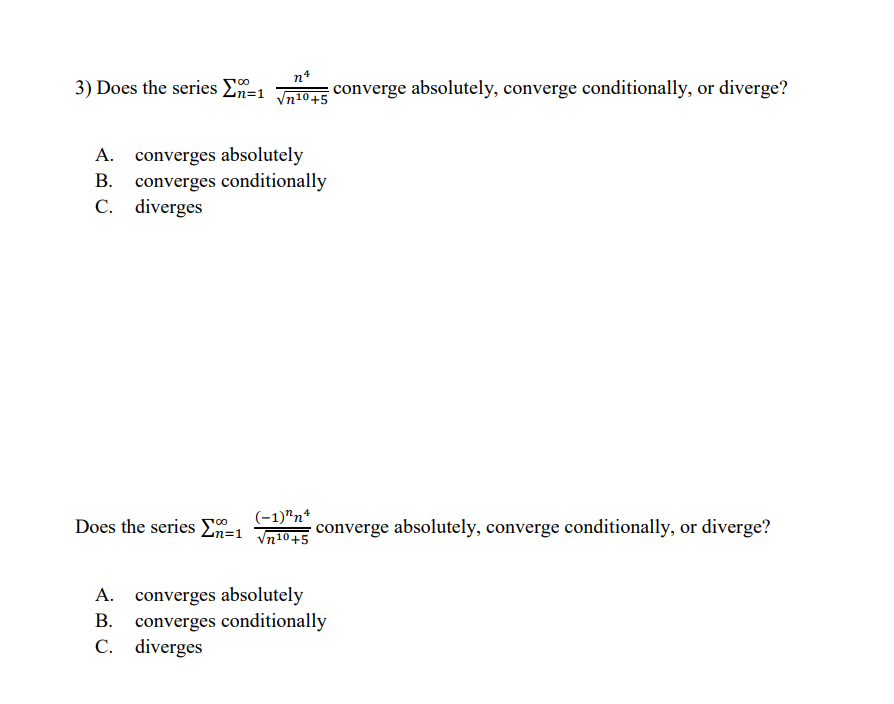
3) Does the series ( sum_{n=1}^{infty} frac{n^{4}}{sqrt{n^{10}+5}} ) converge absolutely, converge conditionally, or diverge? A. converges absolutely B. converges conditionally C. diverges Does the series ( sum_{n=1}^{infty} frac{(-1)^{n} n^{4}}{sqrt{n^{10}+5}} ) converge absolutely, converge conditionally, or diverge? A. converges absolutely B. converges conditionally C. diverges
View Answer
divider
ANSWERED

Vincenzo Zaccaro verified

Numerade educator

1) We want to use the alternating series test to determine if the series [ sum_{k=4}^{infty}(-1)^{k+2} frac{k^{5}}{sqrt{k^{12}+12}} ] converges or diverges. We can conclude that: A. The alternating series test does not apply because the absolute value of the terms are not decreasing. B. The series converges by the alternating series test. C. The series diverges by the alternating series test. D. The alternating series test does not apply because the absolute value of the terms do not approach 0 , and the series diverges for the same reason. E. The alternating series test does not apply because the terms of the series do not alternate.

View Answer
divider
ANSWERED

Andrew Noble verified

Numerade educator

Classwork 5.1 Sequences Name/s: 1a) Suppose ( a_{n}=-2 a_{n-1}-5 a_{n-2}-3 a_{n-3} ) and suppose ( a_{4}=17, a_{5}=-44 ), and ( a_{6}=-3 ) .Find ( a_{1}, a_{2} ), and ( a_{3} ). [ egin{array}{l} a_{1}= \ a_{2}= \ a_{3}= end{array} ]

View Answer
divider