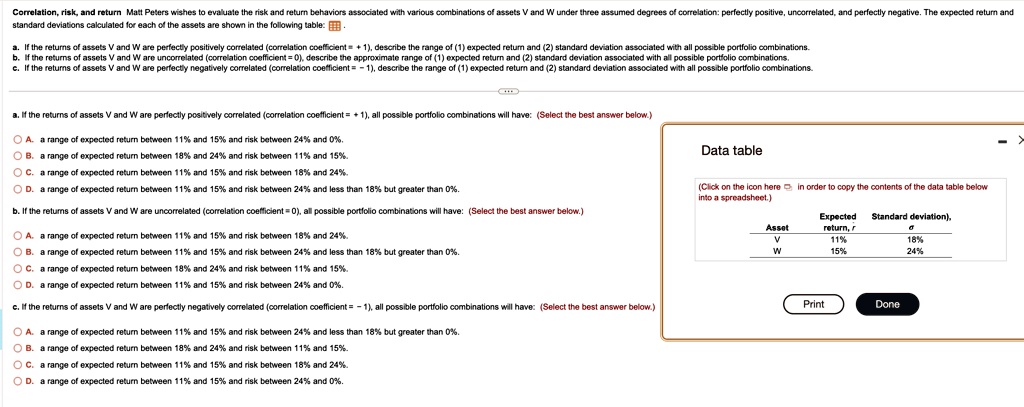
Correlation, risk, and return Matt Peters wishes to evaluate the risk and return behaviors associated with various combinations of assets V and W under three assumed degrees of correlation: perfectly positive, uncorrelated, and perfectly negative. The expected return and
standard deviations calculated for each of the assets are shown in the following table:
If the returns of assets V and W are perfectly positively correlated (correlation coefficient + 1), describe the range of (1) expected return and (2) standard deviation associated with all possible portfolio combinations.
b. If the returns of assets V and W are uncorrelated (correlation coefficient = 0), describe the approximate range of (1) expected return and (2) standard deviation associated with all possible portfolio combinations.
If the returns of assets V and W are perfectly negatively correlated (correlation coefficient = -1), describe the range of (1) expected return and (2) standard deviation associated with all possible portfolio combinations.
a. If the returns of assets V and W are perfectly positively correlated (correlation coefficient = + 1), all possible portfolio combinations will have: (Select the best answer below.)
A. a range of expected return between 11% and 15% and risk between 24% and 0%.
B.
a range of expected return between 18% and 24% and risk between 11% and 15%.
C.
a range of expected return between 11% and 15% and risk between 18% and 24%.
Data table
D. a range of expected return between 11% and 15% and risk between 24% and less than 18% but greater than 0%.
b. If the returns of assets V and W are uncorrelated (correlation coefficient = 0), all possible portfolio combinations will have: (Select the best answer below.)
(Click on the icon here in order to copy the contents of the data table below
into a spreadsheet.)
A. a range of expected return between 11% and 15% and risk between 18% and 24%.
B.
a range of expected return between 11% and 15% and risk between 24% and less than 18% but greater than 0%.
C.
a range of expected return between 18% and 24% and risk between 11% and 15%.
D. a range of expected return between 11% and 15% and risk between 24% and 0%.
c. If the returns of assets V and W are perfectly negatively correlated (correlation coefficient = -1), all possible portfolio combinations will have: (Select the best answer below.)
A. a range of expected return between 11% and 15% and risk between 24% and less than 18% but greater than 0%.
B.
a range of expected return between 18% and 24% and risk between 11% and 15%.
C.
a range of expected return between 11% and 15% and risk between 18% and 24%.
D.
a range of expected return between 11% and 15% and risk between 24% and 0%.
Expected Standard deviation),
Asset
V
return, r
σ
W
11%
15%
18%
24%