Ace - AI Tutor
Ask Our Educators
Textbooks
My Library
Flashcards
Scribe - AI Notes
Notes & Exams
Download App
linda luna

linda l.

Divider

Questions asked

BEST MATCH

Repeat part (b) using eight subintervals instead of four. In addition to the problems from the textbook,you should complete the following problems. 1.Let f=-2lnWe are interested in the area of the region E enclosed by the lines =1andx=5,thex-axis,and the graph of f. @ Use MATLAB (or your preferred plotting software to graph f on the interval [1,5] Include an image of the figure. b Make a detailed sketch of the approximating rectangles representing the Riemann sum approximation for the area of E using four subintervals and right endpoints as sample points.Compute the corresponding Riemann sum. c Repeat part b using eight subintervals instead of four.

View Answer
divider
BEST MATCH

Which membrane protein directly responds to the depolarization of autorhythmic cardiomyocytes? a. Voltage-gated sodium ion channels b. Voltage-gated calcium ion channels c. Voltage-gated potassium ion channels d. Ryanodine receptors (RyR)

View Answer
divider
BEST MATCH

Calculate the derivative of the function. \begin{equation*} h(t) = 3\sqrt{t} - \frac{4}{\sqrt{t}} \end{equation*} (Express numbers in exact form. Use symbolic notation) \begin{equation*} h'(t) = \\ \end{equation*}

View Answer
divider
BEST MATCH

P?=100 41° 53° 33° P?=300 P?=300 Resultant vector =? angle of the resultant vector with the horizontal axis.

View Answer
divider
BEST MATCH

Problem. 9: Use Euler's method with $n = 4$ and $n = 6$ to obtain approximations to the solution of the initial problem when $x = b$. (Round your answers to three decimal places.) (a) $n = 4$ $y' = 7x^2 + y$, $y(0) = 1$; $b = 1$ (b) $n = 6$

View Answer
divider
BEST MATCH

1 + \frac{1}{(1+2)} + \frac{1}{(1+2+3)} + ... + \frac{1}{(1+2+3+...+n)} = \frac{2n}{n+1}

View Answer
divider
BEST MATCH

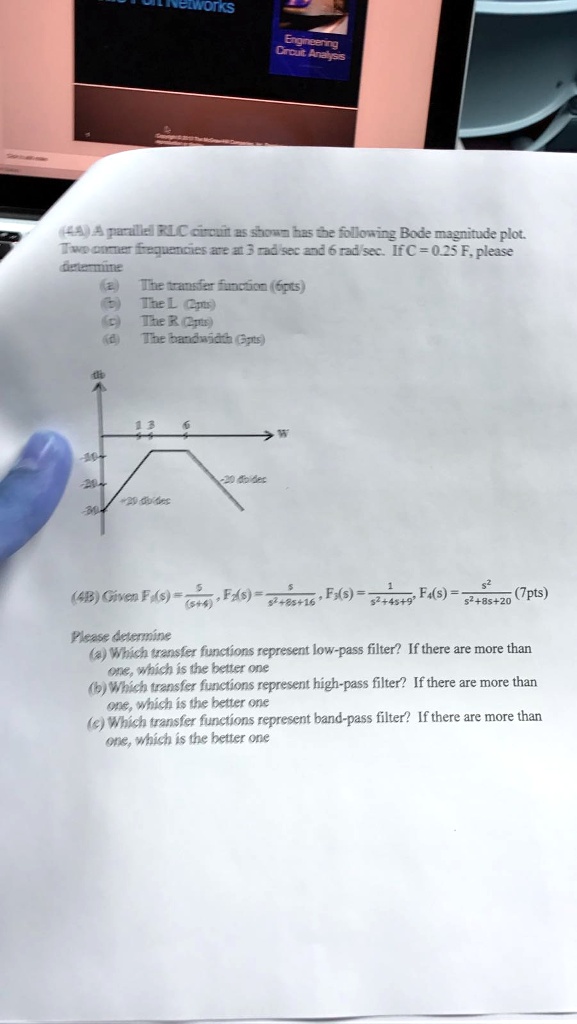
(4A) A parallel RLC circuit as shown has the following Bode magnitude plot. Two corner frequencies are at 3 rad/sec and 6 rad/sec. If C = 0.25 F, please determine (a) The transfer function (6pts) (b) The L (2pts) (c) The R (2pts) (d) The bandwidth (3pts) (4B) Given $F_1(s) = \frac{5}{(s+4)}$, $F_2(s) = \frac{s}{s^2+4s+16}$, $F_3(s) = \frac{1}{s^2+4s+9}$ $F_4(s) = \frac{s^2}{s^2+8s+20}$ (7pts) Please determine (a) Which transfer functions represent low-pass filter? If there are more than one, which is the better one (b) Which transfer functions represent high-pass filter? If there are more than one, which is the better one (c) Which transfer functions represent band-pass filter? If there are more than one, which is the better one
View Answer
divider
BEST MATCH

Question 5 There are several considerations in forming a business including all the following except: autonomy owner's liability ease of creation accounting methods taxation 2 pts

View Answer
divider
BEST MATCH

Important: Answer the following question and justify your answers: In Fig. Qla, assume $P_t = 10W$, $G_t = 10 dB$, $G_r = 3dB$ at 900MHz. The received power for the diffracted signal is -70 dBm [Note: You may use Fig. Qlb in your calculations] a) Obtain the diffraction Gain $G_d(v)$. b) Obtain the height of the obstruction. c) How many complete Fresnel Zones does the obstruction cover.

View Answer
divider
BEST MATCH

MATERIALS MANUFACTURING MARKETING ENERGY RECYCLE DISPOSAL

View Answer
divider