16.2-2.* Silicon Dynamics has developed a new clomputer chip that
will enable it to begin producing and marketing a personal computer
if it so desires. Alternatively, it can sell the rights to the computer
chip for $15 million. If the company chooses to build computers, the
profitability of the venture depends upon the company's ability to
market the computer during the first year. It has sufficient access to
retail outlets that it can guarantee sales of 10,000 computers. On the
other hand, if this computer catches on, the company can sell 100,000
computers. For analysis purposes, these two levels of sales are taken
to be the two possible outcomes of marketing the computer, but it
is unclear what their prior probabilities are. If the decision is to go
ahead with producing and marketing the computer, the company will
produce as many chips as it finds it will be able to sell, but not more.
The cost of setting up the assembly line is $6 million. The differ-
ence between the selling price and the variable cost of each com-
puter is $600.
(a) Develop a decision analysis formulation of this problem by
identifying the decision alternatives, the states of nature, and
the payoff table.
(b) Develop a graph that plots the expected payoff for each of the
decision alternatives versus the prior probability of selling
10,000 computers.
(c) Referring to the graph developed in part (b), use algebra to
solve for the crossover point. Explain the significance of this
point.
A (d) Develop a graph that plots the expected payoff (when using
Bayes' decision rule) versus the prior probability of selling
10,000 computers.
(e) Assuming the prior probabilities of the two levels of sales are
both 0.5 , which decision alternative should be chosen?
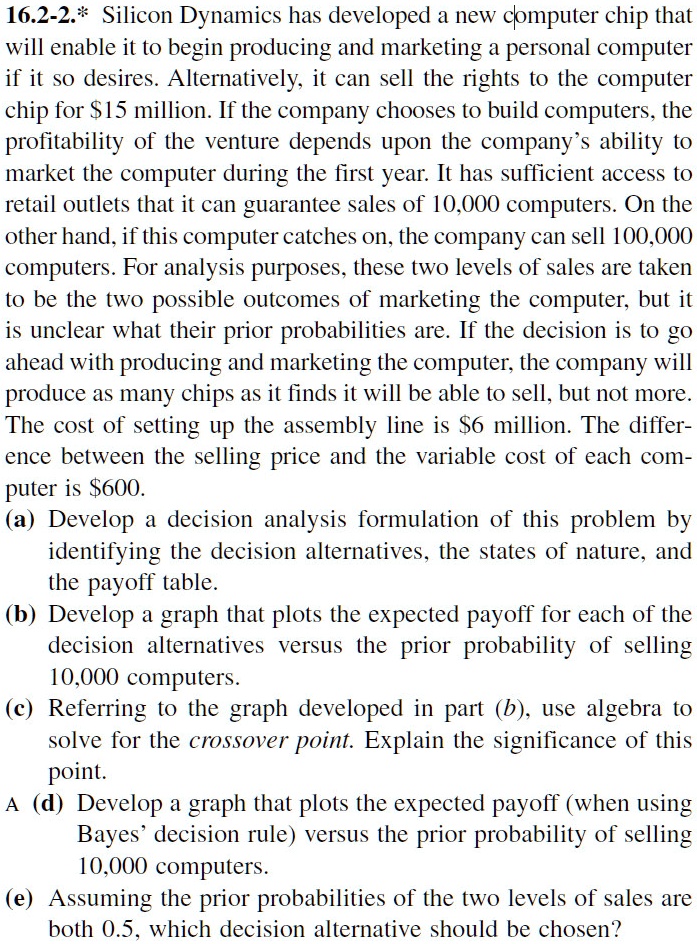
16.2-2.* Silicon Dynamics has developed a new computer chip that will enable it to begin producing and marketing a personal computer if it so desires.Alternatively, it can sell the rights to the computer chip for $15 million.If the company chooses to build computers,the profitability of the venture depends upon the company's ability to market the computer during the first year. It has sufficient access to retail outlets that it can guarantee sales of 10,000 computers. On the other hand, if this computer catches on, the company can sell 100,000 computers. For analysis purposes, these two levels of sales are taken to be the two possible outcomes of marketing the computer, but it is unclear what their prior probabilities are. If the decision is to go ahead with producing and marketing the computer, the company will produce as many chips as it finds it will be able to sell, but not more The cost of setting up the assembly line is $6 million. The differ ence between the selling price and the variable cost of each com puter is $600. (a) Develop a decision analysis formulation of this problem by identifying the decision alternatives, the states of nature, and the payoff table. (b) Develop a graph that plots the expected payoff for each of the decision alternatives versus the prior probability of selling 10.000 computers. (c) Referring to the graph developed in part (b), use algebra to solve for the crossover point. Explain the significance of this point. A (d) Develop a graph that plots the expected payoff (when using Bayes' decision rule) versus the prior probability of selling 10,000 computers. (e) Assuming the prior probabilities of the two levels of sales are both O.5.which decision alternative should be chosen?