Part 2: Detailed Analysis Questions (70 Points total)
1. (35 pts) Recently, a number of research projects have been conducted to develop opaque surfaces for passive radiative cooling of buildings. The basic concept of these surfaces is that they are highly reflecting of solar irradiation and most irradiation from Earth's atmosphere, but are highly emissive in a specific wavelength band (8–13 µm) for which the atmosphere is nearly transparent (and therefore, low-emitting). As a result, they can cool down below the local air temperature.
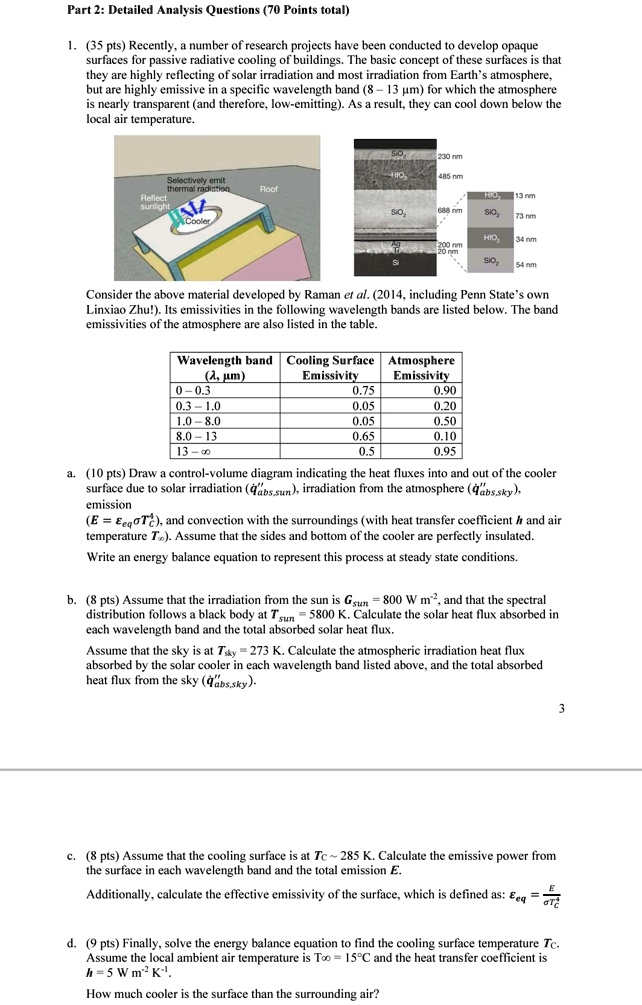
Consider the above material developed by Raman et al. (2014, including Penn State's own Linxiao Zhu!). Its emissivities in the following wavelength bands are listed below. The band emissivities of the atmosphere are also listed in the table.
Wavelength band Cooling Surface Atmosphere (µm) Emissivity Emissivity
0.3-0.75 0.90 0.30 1.0 0.05 0.20 1.0-8.0 0.05 0.50 8.0-13 0.65 0.10 13-∞ 0.95
a. (10 pts) Draw a control-volume diagram indicating the heat fluxes into and out of the cooler surface due to solar irradiation (qabs,sun), irradiation from the atmosphere (qabssky), emission (E = εσT^4), and convection with the surroundings (with heat transfer coefficient h and air temperature T). Assume that the sides and bottom of the cooler are perfectly insulated. Write an energy balance equation to represent this process at steady state conditions.
b. (8 pts) Assume that the irradiation from the sun is Gsun = 800 W/m^2, and that the spectral distribution follows a black body at Tsun = 5800 K. Calculate the solar heat flux absorbed in each wavelength band and the total absorbed solar heat flux. Assume that the sky is at Tsky = 273 K. Calculate the atmospheric irradiation heat flux absorbed by the solar cooler in each wavelength band listed above, and the total absorbed heat flux from the sky (qabs,sky).
c. (8 pts) Assume that the cooling surface is at Tc ≈ 285 K. Calculate the emissive power from the surface in each wavelength band and the total emission E.
d. (9 pts) Finally, solve the energy balance equation to find the cooling surface temperature Tc. Assume the local ambient air temperature is T∞ = 15°C and the heat transfer coefficient is h = 5 W/m^2 K. How much cooler is the surface than the surrounding air?