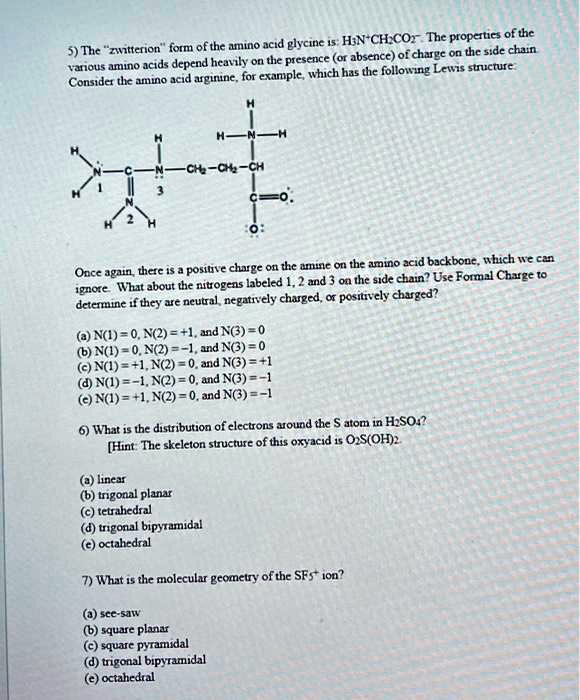
5) The "zwitterion" form of the amino acid glycine is: H$_3$N$^+$CH$_2$CO$_2$$^-$. The properties of the
various amino acids depend heavily on the presence (or absence) of charge on the side chain
Consider the amino acid arginine, for example, which has the following Lewis structure:
H
H
H
H-N-H
H$_3$N$^+$ -CH$_2$-CH$_2$-CH
H
3
N
H
2 H
CO$_2$$^-$
Once again, there is a positive charge on the amine on the amino acid backbone, which we can
ignore. What about the nitrogens labeled 1, 2 and 3 on the side chain? Use Formal Charge to
determine if they are neutral, negatively charged, or positively charged?
(a) N(1) = 0, N(2) = +1, and N(3) = 0
(b) N(1) = 0, N(2) = -1, and N(3) = 0
(c) N(1) = +1, N(2) = 0, and N(3) = +1
(d) N(1) = -1, N(2) = 0, and N(3) = -1
(e) N(1) = +1, N(2) = 0, and N(3) = -1
6) What is the distribution of electrons around the S atom in H$_2$SO$_4$?
[Hint: The skeleton structure of this oxyacid is O$_2$S(OH)$_2$.
(a) linear
(b) trigonal planar
(c) tetrahedral
(d) trigonal bipyramidal
(e) octahedral
7) What is the molecular geometry of the SF$_5$$^+$ ion?
(a) see-saw
(b) square planar
(c) square pyramidal
(d) trigonal bipyramidal
(e) octahedral