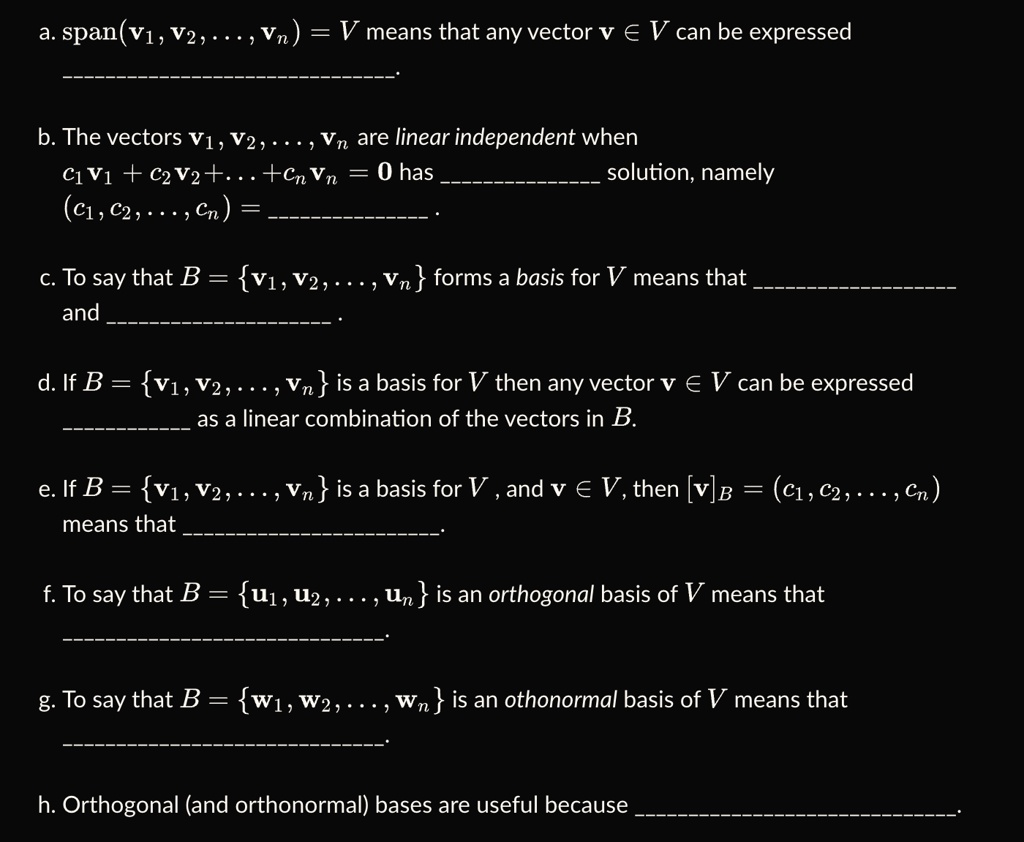
a. span\(V_1, V_2, ..., V_n\) = V means that any vector v ? V can be expressed
b. The vectors V_1, V_2,..., V_n are linear independent when
C_1V_1 + C_2V_2+...+C_nV_n = 0 has ________ solution, namely
(C_1, C_2,..., C_n) = ________.
c. To say that B = \{V_1, V_2, ..., V_n\} forms a basis for V means that ______ and ______.
d. If B = \{V_1, V_2, ..., V_n\} is a basis for V then any vector v ? V can be expressed
as a linear combination of the vectors in B.
e. If B = \{V_1, V_2, ..., V_n\} is a basis for V, and v ? V, then [v]_B = (C_1, C_2, ..., C_n)
means that ______.
f. To say that B = \{u_1, u_2, ..., u_n\} is an orthogonal basis of V means that ______.
g. To say that B = \{w_1, w_2, ..., w_n\} is an orthonormal basis of V means that ______.
h. Orthogonal (and orthonormal) bases are useful because ______.