Please explain the theory behind and provide step-by-step work to achieve the final answer, thank you.
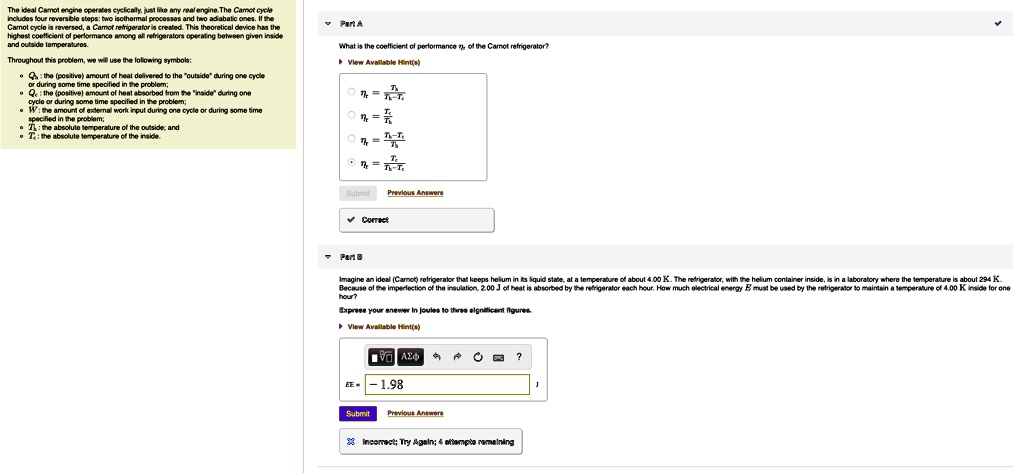
The Carnot cycle operates cyclically, just like any heat engine. The Carnot cycle includes four reversible steps: two isothermal processes and two adiabatic ones. If the Carnot cycle is reversed, a Carnot refrigerator is created. This theoretical device has the highest coefficient of performance among all refrigerators operating between given inside and outside temperatures. Throughout this problem, we will use the following symbols: Q, the positive amount of heat delivered to the outside during one cycle or during some time specified in the problem; Q, the positive amount of heat absorbed from the inside during one cycle or during some time specified in the problem; W, the amount of work input during one cycle or during some time specified in the problem; T, the absolute temperature of the outside; and T, the absolute temperature of the inside.
Part A
What is the coefficient of performance, COP, of the Carnot refrigerator? View Available Hint(s)
COP = Q / W
COP = T / (T - T)
Part B
Imagine an ideal Carnot refrigerator that keeps helium in its liquid state, at a temperature of about 4.00 K. The refrigerator, with the helium container inside, is in a laboratory where the temperature is about 294 K. Because of the imperfection of the insulation, 2.00 J of heat is absorbed by the refrigerator to maintain a temperature of 4.00 K inside for one hour?
Magnificent figures
View Available Hint(s)
- 1.98
Incorrect; Try Again; 6 attempts remaining