Ace - AI Tutor
Ask Our Educators
Textbooks
My Library
Flashcards
Scribe - AI Notes
Notes & Exams
Download App
lisa duncan

lisa d.

Divider

Questions asked

BEST MATCH

3. From the BJT circuit below, assume $V_{BE} = 0.7$ V. and $\beta = 100$, find $V_{CE}$

View Answer
divider
BEST MATCH

What is the part of working memory where one can hold and manipulate visual memory called?

View Answer
divider
BEST MATCH

(a) A physicist connects a 7.50 V battery to the plates of a capacitor. After waiting a while, the capacitor reaches a maximum amount of 22.0 µC of stored charge. What is the value of the capacitance (in µF)? µF (b) The capacitor is disconnected from the battery, discharged, and then connected to a 10.0 V battery. Again, a long enough time is waited for the capacitor to fully charge. How much charge (in µC) is stored now? (Assume the capacitor can handle this new voltage without failing.) µC

View Answer
divider
BEST MATCH

Inattentional blindness is more likely to occur when O the distracting stimulus is similar to the relevant stimuli of the task at hand. O a person is colorblind. O a task is difficult and occupying. O the distracting stimulus is below the absolute threshold.

View Answer
divider
BEST MATCH

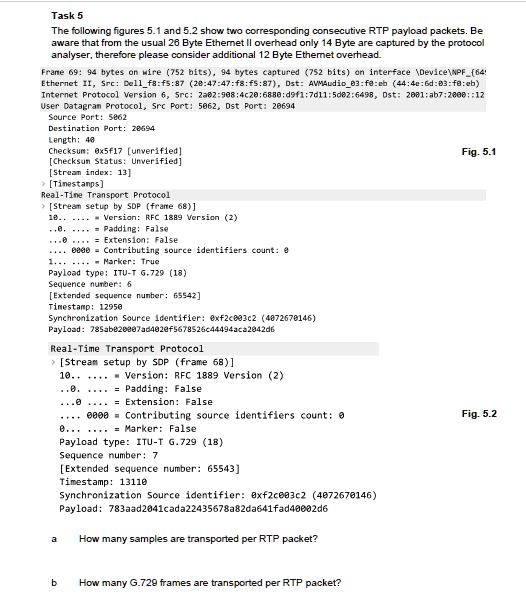
Task 5 The following figures 5.1 and 5.2 show two corresponding consecutive RTP payload packets. Be aware that from the usual 26 Byte Ethernet II overhead only 14 Byte are captured by the protocol analyzer, therefore please consider additional 12 Byte Ethernet overhead. Frame 69: 94 bytes on wire (752 bits), 94 bytes captured (752 bits) on interface Device WPF_(64: Ethernet II, Src: Dell_f8:f5:87 (2e:47:47:f8:fs:87), Dst: AMMAdio_83:fa:eb (44:4e:6d:e3:fe:eb) Internet Protocol version 6, Src: 2a02:998:4c20:68:80:d9f1:7d11:5de2:6498, Dst: 2001:ab7:20e heta ::12 User Datagram Protocol, Src Port: 5062, Dst Port: 26694 Source Port: 5862 Destination Port: 20694 Length: 40 Checksum: ax5f17 [unverified] [Checksum Status: Unverified] Fig. 5.1 [Stream index: 13] [Timestamps] Real-Time Transport Protocol [Stream setup by SDP (frame 68)] 10.. .... = Version: RFC 1889 Version (2) , e.,.. = Padding: False .... ,.... = Extension: False .... ออeอ = Contributing source identifiers count: a 1... .... = Marker: True Payload type: ITU-T G.729 (18) Sequence number: 6 [Extended sequence number: 65542] Timestamp: 12950 Synchronization Source identifier: exf2c893c2 (407267e146) Payload: 785abe26ee7ad492ef5678526c44494aca2842d6 Real-Time Transport Protocol [Stream setup by SDP (frame 68)] 10.. ... . . Version: RFC 1889 Version (2) ..b. ,... = Padding: False .... ,... = Extension: False .... 90⊖ heta = Contributing source identifiers count: heta Fig. 5.2 日... .... = Marker: False Payload type: ITU-T G.729 (18) Sequence number: 7 [Extended sequence number: 65543] Timestamp: 13110 Synchronization Source identifier: exf2c603c2 (4672679146) Payload: 783aad2041cada22435678a82da641fad40ea2d6 a How many samples are transported per RTP packet? b How many G.729 frames are transported per RTP packet?
View Answer
divider
BEST MATCH

Discuss the various forms in which wealth can be accumulated.

View Answer
divider
BEST MATCH

Which scenario shows a production function at work? Question 11 options: a) You write a personal letter to your family. b) You buy flour and eggs and bake a cake to sell in your bakery. c) You go to the library and read a book. d) You go to Home Depot and buy some paint.

View Answer
divider
BEST MATCH

Texts: The concentration of NO2 was measured at the following times for the following reaction: 2NO2(g) → 2NO(g) + O2(g) time [NO2] 0 s 0.1103 M 65.0 s 0.1076 M 130.0 s 0.1050 M a) What formula would you use to calculate the average rate of disappearance of NO2 from 65.0 s to 130.0 s? b) How would you find the rate of reaction if the rate of disappearance of NO2 is 4.11x10⁻³ M/s?

View Answer
divider
BEST MATCH

When a system of free particles is developed under the density matrix formalism, it is not necessary to resort to correcting with a factor N!, explain the reason.

View Answer
divider
BEST MATCH

Unit Problem: A sample of an unknown metal (c = 0.285 J/g*K) is heated to an initial temperature of 81.9 °C. It is added to a 28.49 g sample of water (c = 4.184 J/g*K), raising the temperature of the water from 24.7 °C to a final temperature of 28.6 °C. What is the mass of the metal, assuming no heat is lost to the calorimeter? A) Hypothesis: State your strategy for how to solve the problem in 2-4 sentences. Note that this should be targeted toward the specific example you are solving (i.e., do not just give a vague overview that could apply to solving any problem), but also should not go into the details or step-by-step instructions (save this for part D) B) Experimental Design: State three definitions and/or problem-solving rules that are necessary to complete the problem (1-2 sentences each). Ensure that you connect the rule/definition specifically with how it will be applied in the problem. See the Sample Quiz for examples. C) Solve: Complete the provided problem, showing all steps involved. This will often be best done by handwriting your work and including a picture of this work, rather than attempting to format within this Word document. This section should not include sentence explanations for the steps taken. D) Explanation: Explain, in 6-10 complete sentences and in your own words, all of the steps and considerations used to solve the problem above.

View Answer
divider