Ace - AI Tutor
Ask Our Educators
Textbooks
My Library
Flashcards
Scribe - AI Notes
Notes & Exams
Download App
lisa gonzalez

lisa g.

Divider

Questions asked

BEST MATCH

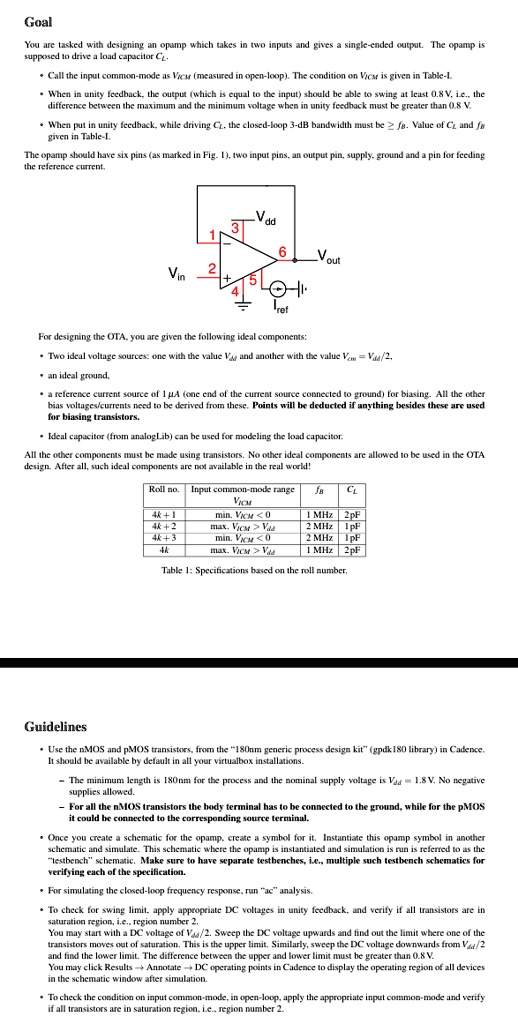
Goal You are tasked with designing an opamp which takes in two inputs and gives a single-ended output. The opamp is supposed to drive a load capacitor $C_L$. • Call the input common-mode as $V_{ICM}$ (measured in open-loop). The condition on $V_{ICM}$ is given in Table-I. • When in unity feedback, the output (which is equal to the input) should be able to swing at least 0.8 V, i.e., the difference between the maximum and the minimum voltage when in unity feedback must be greater than 0.8 V. • When put in unity feedback, while driving $C_L$, the closed-loop 3-dB bandwidth must be $\ge f_B$. Value of $C_L$ and $f_B$ given in Table-I. The opamp should have six pins (as marked in Fig. 1), two input pins, an output pin, supply, ground and a pin for feeding the reference current. For designing the OTA, you are given the following ideal components: • Two ideal voltage sources: one with the value $V_{dd}$ and another with the value $V_{cm} = V_{dd}/2$. • an ideal ground. • a reference current source of 1 $\mu$A (one end of the current source connected to ground) for biasing. All the other bias voltages/currents need to be derived from these. Points will be deducted if anything besides these are used for biasing transistors. • Ideal capacitor (from analogLib) can be used for modeling the load capacitor. All the other components must be made using transistors. No other ideal components are allowed to be used in the OTA design. After all, such ideal components are not available in the real world! Table 1: Specifications based on the roll number Guidelines • Use the nMOS and pMOS transistors, from the "180nm generic process design kit" (gpdk180 library) in Cadence. It should be available by default in all your virtualbox installations. – The minimum length is 180nm for the process and the nominal supply voltage is $V_{dd} = 1.8$ V. No negative supplies allowed. – For all the nMOS transistors the body terminal has to be connected to the ground, while for the pMOS it could be connected to the corresponding source terminal. • Once you create a schematic for the opamp, create a symbol for it. Instantiate this opamp symbol in another schematic and simulate. This schematic where the opamp is instantiated and simulation is run is referred to as the "testbench" schematic. Make sure to have separate testbenches, i.e., multiple such testbench schematics for verifying each of the specification. • For simulating the closed-loop frequency response, run "ac" analysis. • To check for swing limit, apply appropriate DC voltages in unity feedback, and verify if all transistors are in saturation region, i.e., region number 2. You may start with a DC voltage of $V_{dd}/2$. Sweep the DC voltage upwards and find out the limit where one of the transistors moves out of saturation. This is the upper limit. Similarly, sweep the DC voltage downwards from $V_{dd}/2$ and find the lower limit. The difference between the upper and lower limit must be greater than 0.8 V. You may click Results $\rightarrow$ Annotate $\rightarrow$ DC operating points in Cadence to display the operating region of all devices in the schematic window after simulation. • To check the condition on input common-mode, in open-loop, apply the appropriate input common-mode and verify if all transistors are in saturation region, i.e., region number 2.
View Answer
divider
BEST MATCH

A 2.7 m3 rigid tank contains steam at 175â—¦ C. One-third of the volume is in the liquid phase and the rest is in the vapor form. Determine (a) the pressure of the steam, (b) the quality of the saturated mixture, and (c) the density of the mixture. (10 pts)

View Answer
divider
BEST MATCH

Consider the compounds 4-tert-butylcyclohexanol and 4-tert-butylcyclohexanone. Using silica gel plates, which of the two compounds will have the lower Rf value when ethyl acetate is the developing solvent? Which will have the lower Rf value when dichloromethane is the developing solvent? ethyl acetate solvent: [ Select ] ["4-tert-butylcyclohexanol", "4-tert-butylcyclohexanone"] dichloromethane solvent: [ Select ] ["4-tert-butylcyclohexanol", "4-tert-butylcyclohexanone"]

View Answer
divider
BEST MATCH

The contrapositive of $(r \land \neg q) \to \neg p$ is $\neg p \to (r \land \neg q)$ $(\neg r \lor q) \to p$ $p \to (\neg r \lor q)$ $\neg p \to \neg (r \land \neg q)$

View Answer
divider
BEST MATCH

Determine the acceleration of block A down the slope in the figure where 59 is the mass of the block in kg and 0.32 is the coefficient of friction. Provide your answer in $m/s^2$ and round to the nearest three decimal places.

View Answer
divider
BEST MATCH

The star Wolf 359 is 7.86 light-years from Earth. Imagine a spaceship that travels from Earth to Wolf 359 at a constant speed of 0.908c. On Earth, we would measure the time it takes for the ship to reach the star to be

View Answer
divider
BEST MATCH

Use Part 1 of the Fundamental Theorem of Calculus to find the derivative of the function.\\ y = \int_{\sin x}^{\cos x} (1 + v^4)^9 dv

View Answer
divider
BEST MATCH

1. [ ]_10] Declare and initialize integer array even[ ] with the first 7 even integers without specifying the array bounds explicitly. int even[MAX] for (int i=1; i<14; i+2) { even[i]=0

View Answer
divider
BEST MATCH

<> newconnect.mheducation.com Week 14_CH.13 Robert Morris University Google Translate Check my work mode: This shows what is correct or incorrect for the work you have completed so far. It does not indicate completion. 3 Problem 13-7 Calculating Returns and Standard Deviations [LO1] Consider the following information: 16.66 points Rate of Return If State Occurs State of Probability of State of Economy Stock A Stock B Economy Recession .15 .06 -.10 Normal .56 .09 .19 Boom .29 .14 .36 a. Calculate the expected return for Stocks A and B. (Do not round intermediate calculations and enter your answers as a percent rounded to 2 decimal places, e.g., 32.16.) b. Calculate the standard deviation for Stocks A and B. (Do not round intermediate calculations and enter your answers as a percent rounded to 2 decimal places, e.g., 32.16.) Answer is complete but not entirely correct. Stock A expected return 10.00 % Stock B expected return 19.58 % Stock A standard 2.76 % deviation Stock B standard 33.84 % deviation < Prev 3 of 6 Next > Return to question 0 &

View Answer
divider
BEST MATCH

9. Use the MATLAB Fourier transform routine to find the spectrum of a waveform consisting of two sinusoids at 200 and 400-Hz. First generate the waveform in a 512-point array assuming a sampling frequency of 1 kHz. Take the Fourier transform of the waveform and plot the magnitude of the full spectrum (i.e., 512 points). Generate a frequency vector as in Example 3.10 so the spectrum plot has a properly scaled horizontal axis. Since the DC term will be zero, there is no need to plot it. [Hint: To generate the waveform, first construct a time vector t, then generate the signal using the code: x=sin(2*pi*f1*t)+sin(2*pi*f2*t) where f1=200, and f2=400.] 10. Use the routine sig_noise to generate a waveform containing 200- and 400-Hz sine waves as in Problem 9, but add noise so that the signal-to-noise ratio (SNR) is -8 dB; i.e., x=sig_noise([200 400], -8,N) where N=512. 271 Plot the magnitude spectrum, but only plot the nonredundant points (2 to N/2) and do not plot the DC term, which again is zero. Repeat for an SNR of -16 dB. Note that the two sinusoids are hard to distinguish at the higher (-16 dB) noise level.

View Answer
divider