6. IR Spectroscopy
Spectroscopy is used as a means of analysis and identification of molecules. After using our
separation and purification techniques and we've isolated a single, pure compound, how do we
know what compound it is? The most useful method involves treating that molecule with
energy, such as light (infrared, ultraviolet or visible) or radio waves. By observing how it
interacts with that energy, we can learn something about its structure. This is the process of
spectroscopy (IR, UV/VIS, NMR, respectively). In Infrared Spectroscopy (IR), a sample is
placed in the path of an IR light beam (4000-650 cm-1). Certain frequencies of light will be
absorbed by the molecule, causing certain bonds to bend or stretch. By measuring these
absorptions and recording them on a spectrum, we can analyze the sample's structure since
certain functional groups have characteristic IR.
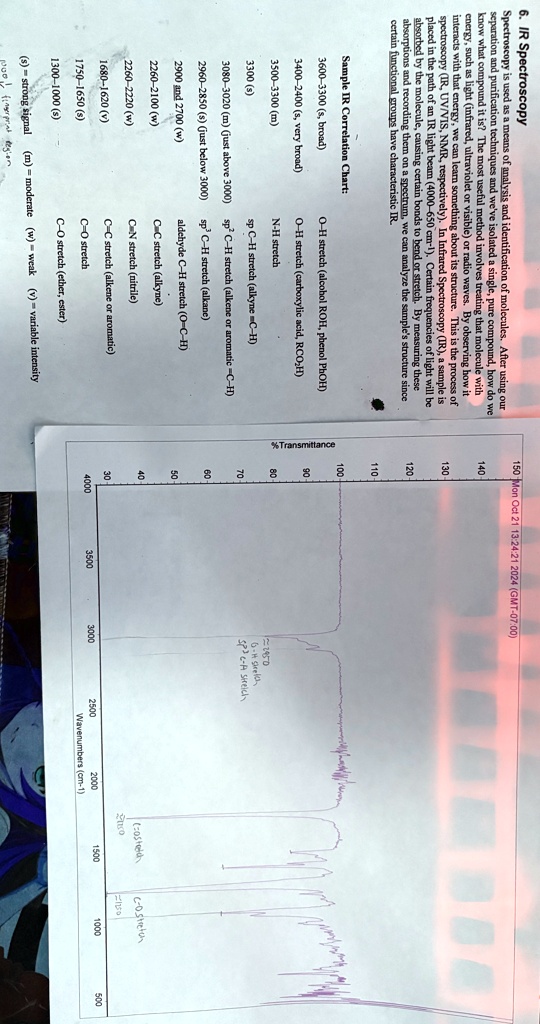
Sample IR Correlation Chart:
3600-3300 (s, broad) O-H stretch (alcohol ROH, phenol PhOH)
3400-2400 (s, very broad) O-H stretch (carboxylic acid, RCO₂H)
3500-3300 (m) N-H stretch
3300 (s) sp C-H stretch (alkyne -C-H)
3080-3020 (m) (just above 3000) sp² C-H stretch (alkene or aromatic -C-H)
2960-2850 (s) (just below 3000) sp³ C-H stretch (alkane)
2900 and 2700 (w) aldehyde C-H stretch (O-C-H)
2260-2100 (w) C=C stretch (alkyne)
2260-2220 (w) CN stretch (nitrile)
1680-1620 (v) C-C stretch (alkene or aromatic)
1750-1650 (s) C-O stretch
1300-1000 (s) C-O stretch (ether, ester)
(s)= strong signal (m) = moderate (w) = weak (v) = variable intensity