Problem Set I:
The probability exam in STA 381 has received a reputation for being quite difficult through the years, so a statistics
instructor decides that she will allow her students the option of playing her special edition of craps to gamble for their
score instead of taking the test. Since STA 381 sections are large, there isn't time to let every interested student roll the
dice several times, so the rules for this special edition allow only two rolls of two six-sided dice.
•
•
•
•
Once a student opts to roll the dice, they no longer have the option of taking the test and receiving the score
they earn.
If the two rolls made by the student satisfy two different conditions as described below, they will receive the
score that is higher.
If the dice total 12 on the first roll, the student will receive a score of 100 regardless of the total on the second
roll.
If the dice total either a 7 or an 11 on both their first roll and second roll, the student will receive a score of 95 on
the exam (i.e., they may receive a 7 on their first roll and an 11 on their second roll or a 11 on their first roll and a
7 on their second roll or a 7 on both or an 11 on both).
If the dice give the same number on the first and second roll, the student will receive a score of 90 on the exam.
If the dice roll a higher number on the second roll than on the first roll, the student will receive a score of 85 on
the exam.
For any other rolls not described above, the student will receive a score of 0 on the exam.
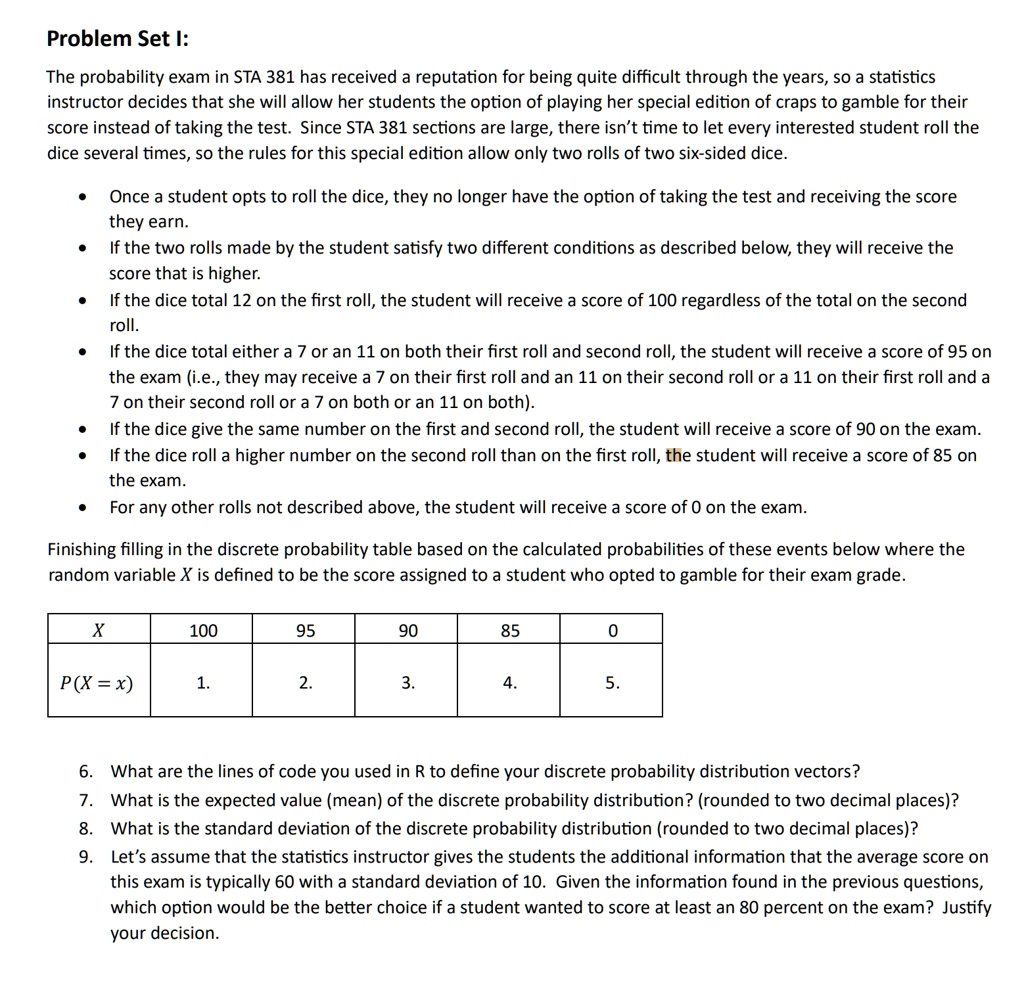
Finishing filling in the discrete probability table based on the calculated probabilities of these events below where the
random variable X is defined to be the score assigned to a student who opted to gamble for their exam grade.
X
100
95
90
85
0
P(X = x)
1.
2.
3.
4.
5.
6. What are the lines of code you used in R to define your discrete probability distribution vectors?
7. What is the expected value (mean) of the discrete probability distribution? (rounded to two decimal places)?
8. What is the standard deviation of the discrete probability distribution (rounded to two decimal places)?
9. Let's assume that the statistics instructor gives the students the additional information that the average score on
this exam is typically 60 with a standard deviation of 10. Given the information found in the previous questions,
which option would be the better choice if a student wanted to score at least an 80 percent on the exam? Justify
your decision.