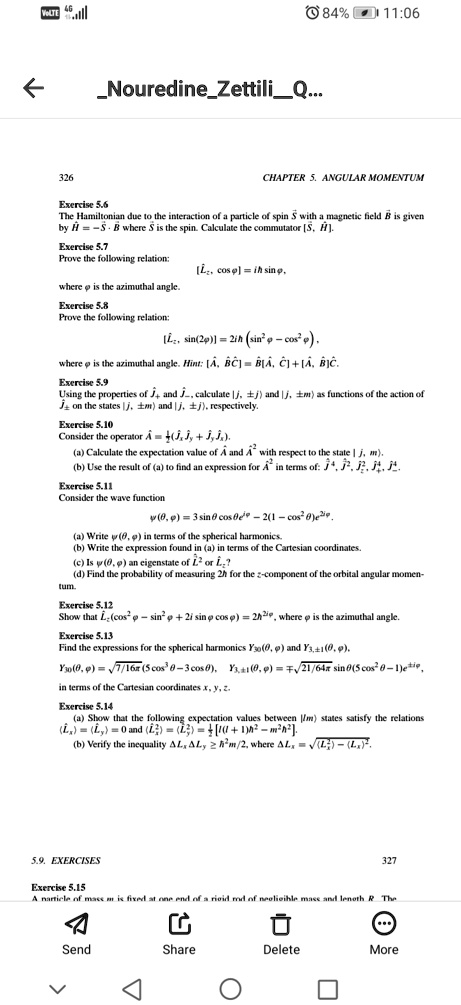
Please answer 5.11
84% 11:06
<
Nouredine_Zettili.Q...
326
CHAPTER 5. ANGULAR MOMENTUM
Exercise 5.6 The Hamiltonian due to the interaction of a particle of spin S with a magnetic field is given by H = S - B where S is the spin. Calculate the commutator [S, H].
Exercise 5.7 Prove the following relation:
[cosθ] = iθsinθ,
where θ is the azimuthal angle.
Exercise 5.8 Prove the following relation: [sin^2θ] = 2iθ (sinθ = cosθ)
where θ is the azimuthal angle. Hint: [A,B] = [A,C] + [A,B]C.
Exercise 5.9 Using the properties of j and j, calculate (j, j) and (j, m) as functions of the action of j on the states (j, m) and (j, j), respectively.
Exercise 5.10 Consider the operator A = j^2 + j,j (a) Calculate the expectation value of A and A^2 with respect to the state |j, m). (b) Use the result of (a) to find an expression for A^2 in terms of j^4, j^2, j, and j.
Exercise 5.11 Consider the wave function ψ(θ, φ) = 3sinθcosθ^2(1 - cos^2θ)e^2iφ
(a) Write ψ(θ, φ) in terms of the spherical harmonics.
(b) Write the expression found in (a) in terms of the Cartesian coordinates.
(c) Is ψ(θ, φ) an eigenstate of L^2 or Lz?
(d) Find the probability of measuring 2h for the z-component of the orbital angular momentum.
Exercise 5.12 Show that L(cos^2θ + sin^2θ + 2i sinθ cosθ) = 2h^2i, where θ is the azimuthal angle.
Exercise 5.13 Find the expressions for the spherical harmonics Y3^0(θ, φ) and Y3^1(θ, φ), Y3^0(θ) = √(7/16π) (5cos^3θ - 3cosθ), Y3^1(θ, φ) = √(21/64π) sin^2θ (5cosθ - 1)eiφ in terms of the Cartesian coordinates x, y, z.
Exercise 5.14 (a) Show that the following expectation values between |m) states satisfy the relations L^2 = y = 0 and Lz = Z = [1 + 1 - m^2/n^2].
(b) Verify the inequality Lz^2 ≤ 2m/2, where Z = √(x^2 + y^2 + z^2) = (x^2 + y^2 + z^2).