Ace - AI Tutor
Ask Our Educators
Textbooks
My Library
Flashcards
Scribe - AI Notes
Notes & Exams
Download App
lisa lamas

lisa l.

Divider

Questions asked

BEST MATCH

Darrin and Samantha Stephens are husband and wife. They have an estate estimated at $20 Million. All property is held as community so that they each have assets valued at $10 Million. Darrin is aged 82 and Samantha 79. They have one daughter, Tabitha, age 49. The Stephens would like Tabitha to eventually inherit their assets and would like to avoid any estate tax, if possible. Tabitha is married but the Stephens do not like her husband. Tabitha also does not seem to like her husband, who regularly calls her a witch. Upon the death of the first to die, they want to assure the survivor that the total family assets will be available for any needs of the survivor. The survivor's needs will take precedence over Tabitha. Explain to Darrin and Samantha how the assets of the first to die can be placed in a trust that will bypass the estate of the survivor, while allowing the survivor access to all trust assets if needed. Include an explanation of a HEMS power for the survivor. Also address a 5 or 5 power. The Stephens have also expressed an interest in making annual gifts to Tabitha. Explain how much they can give without filing anything with the IRS, and whether it is necessary for any election to split the gift to be made. They do not want Tabitha's husband to receive any of these gifts.

View Answer
divider
BEST MATCH

Evaluate the expression below without using a calculator. cos 2 tan−1 13

View Answer
divider
BEST MATCH

concerned about the health dangers of alcohol conusmption congress passes a bill to double federal tax on all forms of alcohol. studies show that the absolute value of elasticities of demand for various types of alochol are as folllows

View Answer
divider
BEST MATCH

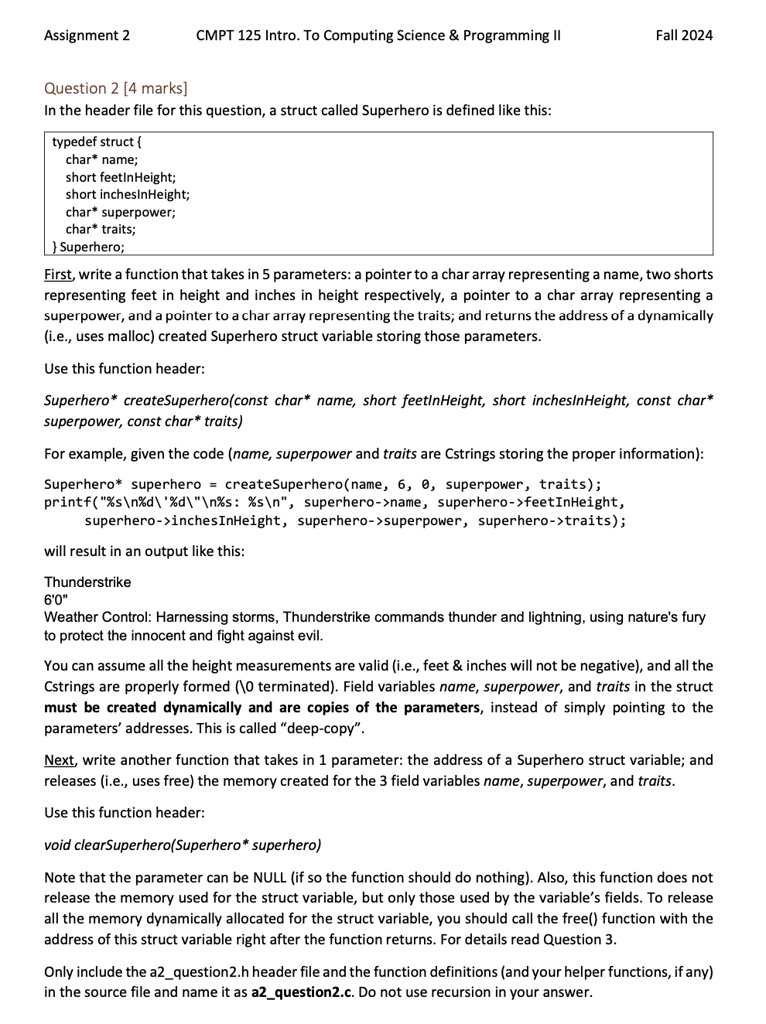
Assignment 2 CMPT 125 Intro. To Computing Science & Programming II Fall 2024 Question 2 [4 marks] In the header file for this question, a struct called Superhero is defined like this: typedef struct { char* name; short feetInHeight; short inchesInHeight; char* superpower; char* traits; } Superhero; First, write a function that takes in 5 parameters: a pointer to a char array representing a name, two shorts representing feet in height and inches in height respectively, a pointer to a char array representing a superpower, and a pointer to a char array representing the traits; and returns the address of a dynamically (i.e., uses malloc) created Superhero struct variable storing those parameters. Use this function header: Superhero* createSuperhero (const char* name, short feetInHeight, short inchesInHeight, const char* superpower, const char* traits) For example, given the code (name, superpower and traits are Cstrings storing the proper information): Superhero* superhero createSuperhero (name, 6, 0, superpower, traits); printf("%s\n%d\'%d\"\n%s: %s\n", superhero->name, superhero->feetInHeight, superhero->inchesInHeight, superhero->superpower, superhero->traits); will result in an output like this: Thunderstrike 6'0" Weather Control: Harnessing storms, Thunderstrike commands thunder and lightning, using nature's fury to protect the innocent and fight against evil. You can assume all the height measurements are valid (i.e., feet & inches will not be negative), and all the Cstrings are properly formed (\0 terminated). Field variables name, superpower, and traits in the struct must be created dynamically and are copies of the parameters, instead of simply pointing to the parameters' addresses. This is called "deep-copy". Next, write another function that takes in 1 parameter: the address of a Superhero struct variable; and releases (i.e., uses free) the memory created for the 3 field variables name, superpower, and traits. Use this function header: void clearSuperhero (Superhero* superhero) Note that the parameter can be NULL (if so the function should do nothing). Also, this function does not release the memory used for the struct variable, but only those used by the variable's fields. To release all the memory dynamically allocated for the struct variable, you should call the free() function with the address of this struct variable right after the function returns. For details read Question 3. Only include the a2_question2.h header file and the function definitions (and your helper functions, if any) in the source file and name it as a2_question2.c. Do not use recursion in your answer.
View Answer
divider
BEST MATCH

Give three examples of work that you have done the past week. Use the physics definition of work.

View Answer
divider
BEST MATCH

Anastasia took out a mortgage of $467,000 for a house and just made the 71st end of month payment. Interest on the loan was 4.22% compounded monthly and the mortgage has a period of 20 years. Round ALL answers to two decimal places if necessary. 1) What are her monthly payments? P/Y = C/Y = N = I/Y = % PV = $ FV = $ PMT = $ 2) What is her current outstanding balance after the 71st payment? BAL = $ (enter a positive value)

View Answer
divider
BEST MATCH

Bonds rated A have a 10% chance of default. Bonds rated B have a 20% chance of default. A portfolio includes 40% A and 60% B-rated bonds. A randomly selected bond is a default bond. Find the probability that the bond is a B-rated bond?

View Answer
divider
BEST MATCH

3. (8 points) (a) Show that with the substitution $z = \ln x$, the differential equation $x^2 y''(x) + xy'(x) + y(x) = 0$ (1) is transformed into the differential equation with constant coefficients: $y''(z) + y(z) = 0$. (2) (Hint: Let $y(x) = y(z)$. Use the Chain Rule.) (b) Solve this new differential equation (2) and use the solution of (2) to solve differential equation (1). Where is the solution to (1) valid?

View Answer
divider
BEST MATCH

Part II Financial reporting by listed groups using IFRS or US GAAP 5.2* Using the reconciliations of this chapter and the information in Chapter 2, comment on the adjustments necessary when moving from German or UK accounting to US or IFRS accounting. 5.3 Explain the advantages and disadvantages of writing accounting standards containing principles rather than rules. 5.4 Discuss the high-level differences between IFRS and US GAAP. Was the SEC right to demand reconciliations of IFRS to US GAAP from foreign companies that are listed on US exchanges? 5.5 Explain the arguments for and against allowing the IASB and the FASB to compete in the provision of accounting standards. Which arguments are the stronger? 5.6 Access the website of GlaxoSmithKline (www.gsk.com) to explain the differences disclosed in its annual reports between US GAAP and IFRS and UK GAAP from 2004 to 2006. Could these differences (summarized in Tables 1.1 and 1.2) have been smaller if the company had made other choices of options available within IFRS and UK GAAP? Is the size of the differences influenced by the fact that GSK is a pharmaceutical company? 5.7 How do preparers and users of annual financial statements of listed companies cope with international differences? 5.8 Two approaches to measuring conservatism are discussed in the chapter: the comparison of profit figures under different GAAPs; and asymmetric recognition of good and bad news. What are the advantages and disadvantages of each approach? 5.9 Is worldwide application of IFRS going to solve the problems of international financial analysis?

View Answer
divider
BEST MATCH

Assume that a linked list based queue structure has 10 nodes. The first and last items of the queue are deferenced (pointed) with the variables \textit{first} and \textit{last}. Write a function to enqueue a new customer with CID:101. // A struct to keep items struct customer { int CID; item *next; };

View Answer
divider