Q.3 To study the effect that a particular drug has on blood clotting time, a random sample of six people was
treated with the drug, and an independent random sample of seven people was treated with a placebo. Each
subject's blood clotting time (in minutes) was recorded. The sample results are given below:
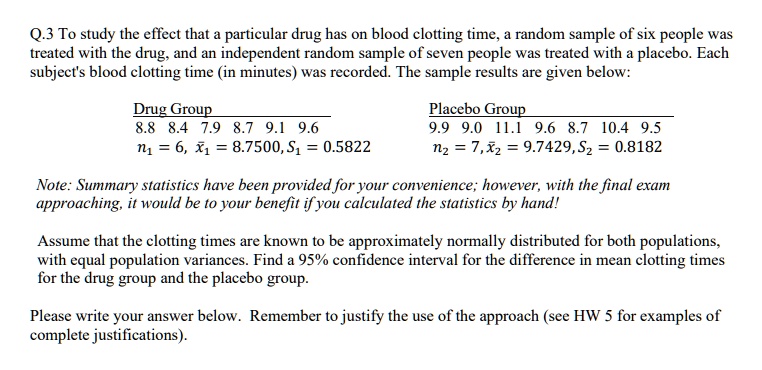
[8.8,8.4,7.9,8.7,9.1,9.6]
n_(1)=6,�ar{x} _(1)=8.7500,S_(1)=0.5822
Drug Group
Placebo Group
9.9,9.0,11.1,9.6,8.7,10.4,9.5
n_(2)=7,�ar{x} _(2)=9.7429,S_(2)=0.8182
Note: Summary statistics have been provided for your convenience; hower, with the final exam
approaching, it would be to your benefit if you calculated the statistics by hand!
Assume that the clotting times are known to be approximately normally distributed for both populations,
with equal population variances. Find a 95% confidence interval for the difference in mean clotting times
for the drug group and the placebo group.
Please write your answer below. Remember to justify the use of the approach (see HW 5 for examples of
complete justifications).
Q.3 To study the effect that a particular drug has on blood clotting time, a random sample of six people was treated with the drug, and an independent random sample of seven people was treated with a placebo. Each subject's blood clotting time (in minutes) was recorded. The sample results are given below:
Drug Group 8.8 8.4 7.9 8.7 9.19.6 n=6,=8.7500,S=0.5822
Placebo Group
n=7,x=9.7429,S=0.8182
Note: Summary statistics have been provided for your convenience; however,with the final exam approaching, it would be to your benefit if you calculated the statistics by hand!
Assume that the clotting times are known to be approximately normally distributed for both populations. with equal population variances. Find a 95% confidence interval for the difference in mean clotting times for the drug group and the placebo group.
Please write your answer below. Remember to justify the use of the approach (see HW 5 for examples of complete justifications).