Ace - AI Tutor
Ask Our Educators
Textbooks
My Library
Flashcards
Scribe - AI Notes
Notes & Exams
Download App
lisa mcdonald

lisa m.

Divider

Questions asked

BEST MATCH

Formula Approach Calculator Approach Excel Approach Find the amount to which $300 will grow under each of these conditions: 8% compounded annually for 6 years. Do not round intermediate calculations. Round your answer to the nearest cent. $ 8% compounded semiannually for 6 years. Do not round intermediate calculations. Round your answer to the nearest cent. $ 8% compounded quarterly for 6 years. Do not round intermediate calculations. Round your answer to the nearest cent. $ 8% compounded monthly for 6 years. Do not round intermediate calculations. Round your answer to the nearest cent. $ 8% compounded daily for 6 years. Assume 365-days in a year. Do not round intermediate calculations. Round your answer to the nearest cent. $ Why does the observed pattern of FVs occur?

View Answer
divider
BEST MATCH

Blossom Company purchased a depreciable asset for $361300. The estimated salvage value is $34400, and the estimated useful life is 10 years. The straight-line method will be used for depreciation. What is the asset's depreciation base? $36130 $361300 $326900 $34400

View Answer
divider
BEST MATCH

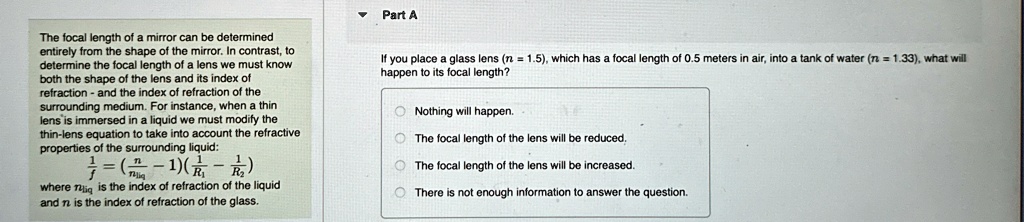
Part A The focal length of a mirror can be determined entirely from the shape of the mirror. In contrast, to determine the focal length of a lens we must know both the shape of the lens and its index of refraction - and the index of refraction of the surrounding medium. For instance, when a thin lens is immersed in a liquid we must modify the thin-lens equation to take into account the refractive properties of the surrounding liquid: $\frac{1}{f} = \left(\frac{n}{n_{liq}} - 1\right)\left(\frac{1}{R_1} - \frac{1}{R_2}\right)$ where $n_{liq}$ is the index of refraction of the liquid and $n$ is the index of refraction of the glass. If you place a glass lens ($n = 1.5$), which has a focal length of 0.5 meters in air, into a tank of water ($n = 1.33$), what will happen to its focal length? Nothing will happen. The focal length of the lens will be reduced. The focal length of the lens will be increased. There is not enough information to answer the question.
View Answer
divider
BEST MATCH

Sketch a circuit (i.e., add to the Mux) to realize the following combinational logic function using a 2 to 1 multiplexer and any glue or inverter gates required. A B X 0 0 0 0 1 1 1 0 1 1 1 0

View Answer
divider
BEST MATCH

a) \( \left|\begin{array}{ccc}7-x & 12 & 6 \\ 10 & 19+x & 10 \\ 12 & 24 & 13-x\end{array}\right|=0 \quad \) b) \( \left|\begin{array}{ccc}5-x & 7 & 5 \\ 0 & 4-x & 1 \\ 2 & 8 & 3+x\end{array}\right|=0 \quad \) c \( \left|\begin{array}{cccc}1 & x & x^{2} & x^{3} \\ 1 & 2 & 4 & 8 \\ 1 & 3 & 9 & 27 \\ 1 & 4 & 16 & 64\end{array}\right|=0 \) ?S: a) \( x=-11 \) b) \( x=1,2 \) c) \( x=2,3,4 \)

View Answer
divider
BEST MATCH

What is the function of microvilli? ? They move a cell through the body. ? They identify a cell as "self" or "foreign." ? They move mucus secretions across the surface of the tissue. ? They increase the surface area for absorption.

View Answer
divider
BEST MATCH

A light beam is emitted at an angle heta _(0) with respect to the x^(')-axi s in S^('). The angle heta the beam makes with the x-axis in S is determined from tan( heta _(0))=tan( heta )/(gamma )(V) tan( heta _(0))=(csin( heta ))/(VV)(ccos( heta )+V) tan( heta )=(cos( heta _(0)))/(r(V)(csin( heta _(0))+V)) tan( heta )=(csin( heta _(0)))/(r(V)(cos( heta _(0))+V)) Alight beam is emitted at an angle Og with respect to the x'-axis in S'.Th angle e the beam makes with the x-axis in S is determined from O tan(0)=tane/yv csin(e) tan(0)= V(ccos(0)+V ccos(e.) tan0= (V(csin()+V csin(0.) O tan= V(ccos(0.)+V

View Answer
divider
BEST MATCH

QUESTION 4 Find the x-intercept(s) of the following rational function: $r(x) = \frac{(x+15)(3x-12)}{4-9x}$

View Answer
divider
BEST MATCH

Find the cost function for the marginal cost function.\ 70\ F'(x) = -\frac{70}{e^{0.08x}} + 600; 2 units cost $1500.\ F(x) =

View Answer
divider
BEST MATCH

Translation in both prokaryotes and eukaryotes occurs in the ribosomes. True or fase

View Answer
divider