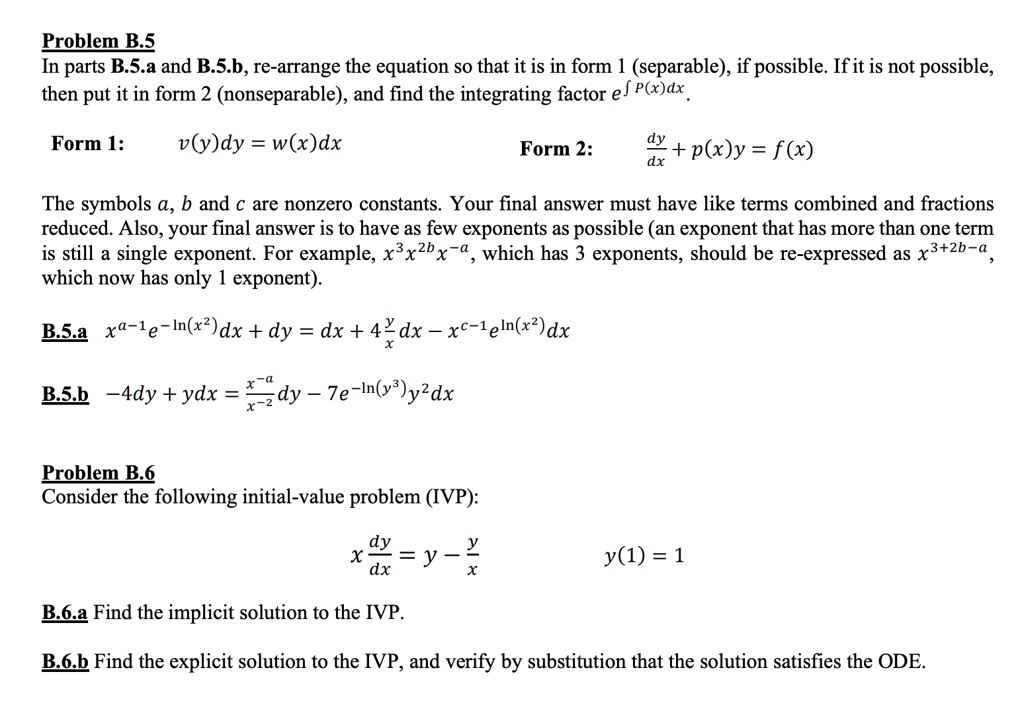
Problem B.5
In parts B.5.a and B.5.b, re-arrange the equation so that it is in form 1 (separable), if possible. If it is not possible,
then put it in form 2 (nonseparable), and find the integrating factor $e^{\int P(x)dx}$.
Form 1: $v(y)dy = w(x)dx$
Form 2: $\frac{dy}{dx} + p(x)y = f(x)$
The symbols $a$, $b$ and $c$ are nonzero constants. Your final answer must have like terms combined and fractions
reduced. Also, your final answer is to have as few exponents as possible (an exponent that has more than one term
is still a single exponent. For example, $x^3x^{2b}x^{-a}$, which has 3 exponents, should be re-expressed as $x^{3+2b-a}$,
which now has only 1 exponent).
B.5.a $x^{a-1}e^{-ln(x^2)}dx + dy = dx + 4\frac{y}{x}dx - x^{c-1}e^{ln(x^2)}dx$
B.5.b $-4dy + ydx = \frac{x^{-a}}{x^{-2}}dy - 7e^{-ln(y^3)}y^2dx$
Problem B.6
Consider the following initial-value problem (IVP):
$x\frac{dy}{dx} = y - \frac{y}{x}$ $y(1) = 1$
B.6.a Find the implicit solution to the IVP.
B.6.b Find the explicit solution to the IVP, and verify by substitution that the solution satisfies the ODE.