Answer all the three questions in the image after reading carefully. All three questions are related to advanced algorithms.
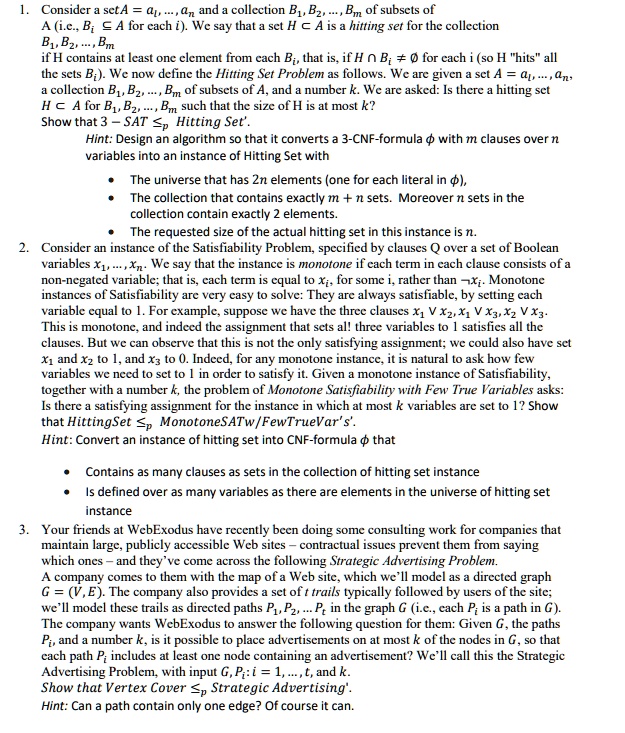
Consider a set A = {a1, a2, ..., an} and a collection B1, B2, ..., Bm of subsets of A (i.e., Bi ⊆ A for each i). We say that a set H ⊂ A is a hitting set for the collection B1, B2, ..., Bm if H contains at least one element from each Bi, that is, if H ∩ Bi ≠ ∅ for each i (so H hits all the sets Bi). We now define the Hitting Set Problem as follows. We are given a set A = {a1, a2, ..., an}, a collection B1, B2, ..., Bm of subsets of A, and a number k. We are asked: Is there a hitting set H ⊆ A for B1, B2, ..., Bm such that the size of H is at most k? Show that 3 - SAT ⊆ Hitting Set. Hint: Design an algorithm so that it converts a 3-CNF-formula with m clauses over n variables into an instance of Hitting Set with the universe that has 2n elements (one for each literal in ), The collection that contains exactly m + n sets. Moreover n sets in the collection contain exactly 2 elements. The requested size of the actual hitting set in this instance is n.
Consider an instance of the Satisfiability Problem, specified by clauses Q over a set of Boolean variables x1, x2, ..., xn. We say that the instance is monotone if each term in each clause consists of a non-negated variable; that is, each term is equal to xi, for some i, rather than ¬xi. Monotone instances of Satisfiability are very easy to solve: They are always satisfiable, by setting each variable equal to 1. For example, suppose we have the three clauses x1 ∨ x2, x2 ∨ x3, x1. This is monotone, and indeed the assignment that sets all three variables to 1 satisfies all the clauses. But we can observe that this is not the only satisfying assignment; we could also have set x1 and x2 to 1, and x3 to 0. Indeed, for any monotone instance, it is natural to ask how few variables we need to set to 1 in order to satisfy it. Given a monotone instance of Satisfiability together with a number k, the problem of Monotone Satisfiability with Few True Variables asks: Is there a satisfying assignment for the instance in which at most k variables are set to 1? Show that Hitting Set ≤p Monotone SAT w/Few True Var's. Hint: Convert an instance of hitting set into CNF-formula that Contains as many clauses as sets in the collection of hitting set instance Is defined over as many variables as there are elements in the universe of hitting set instance.
Your friends at WebExodus have recently been doing some consulting work for companies that maintain large, publicly accessible Web sites - contractual issues prevent them from saying which ones - and they've come across the following Strategic Advertising Problem. A company comes to them with the map of a Web site, which we'll model as a directed graph G = (V, E). The company also provides a set of t trails typically followed by users of the site; we'll model these trails as directed paths P1, P2, ..., Pt in the graph G (i.e., each Pi is a path in G). The company wants WebExodus to answer the following question for them: Given G, the paths Pi, and a number k, is it possible to place advertisements on at most k of the nodes in G, so that each path Pi includes at least one node containing an advertisement? We'll call this the Strategic Advertising Problem, with input G, P, : i = 1, ..., t, and k. Show that Vertex Cover ≤p Strategic Advertising. Hint: Can a path contain only one edge? Of course it can.