Example 7.2
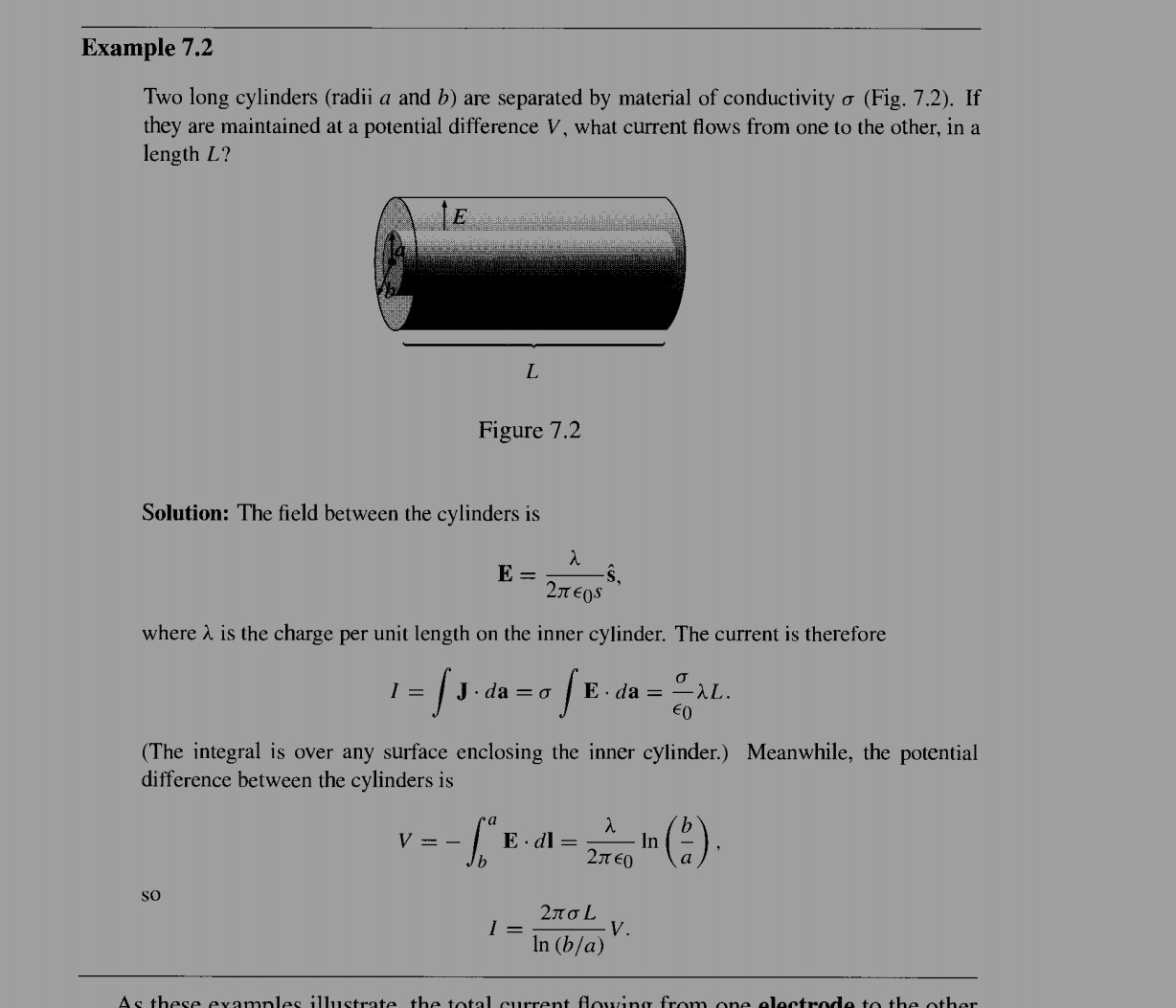
Two long cylinders (radii \( a \) and \( b \) ) are separated by material of conductivity \( \sigma \) (Fig. 7.2). If they are maintained at a potential difference \( V \), what current flows from one to the other, in a length \( L \) ?
Figure 7.2
Solution: The field between the cylinders is
\[
\mathbf{E}=\frac{\lambda}{2 \pi \epsilon_{0} s} \hat{\mathbf{s}},
\]
where \( \lambda \) is the charge per unit length on the inner cylinder. The current is therefore
\[
I=\int \mathbf{J} \cdot d \mathbf{a}=\sigma \int \mathbf{E} \cdot d \mathbf{a}=\frac{\sigma}{\epsilon_{0}} \lambda L .
\]
(The integral is over any surface enclosing the inner cylinder.) Meanwhile, the potential difference between the cylinders is
\[
V=-\int_{b}^{a} \mathbf{E} \cdot d \mathbf{l}=\frac{\lambda}{2 \pi \epsilon_{0}} \ln \left(\frac{b}{a}\right),
\]
so
\[
I=\frac{2 \pi \sigma L}{\ln (b / a)} V
\]