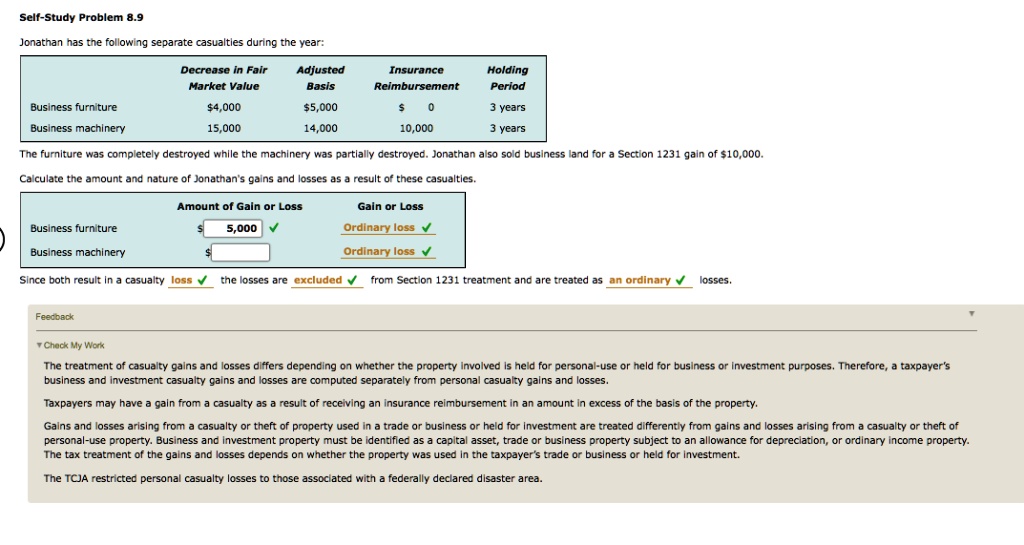
Self-Study Problem 8.9
Jonathan has the following separate casualties during the year:
Business furniture
Business machinery
Decrease in Fair
Market Value
Adjusted
Basis
Insurance
Holding
Reimbursement
Period
$4,000
$5,000
$ 0
3 years
15,000
14,000
10,000
3 years
The furniture was completely destroyed while the machinery was partially destroyed. Jonathan also sold business land for a Section 1231 gain of $10,000.
Calculate the amount and nature of Jonathan's gains and losses as a result of these casualties.
Business furniture
Amount of Gain or Loss
Gain or Loss
$\boxed{5,000}$ ?
Ordinary loss ?
Business machinery
$\boxed{}
Ordinary loss ?
Since both result in a casualty loss the losses are excluded from Section 1231 treatment and are treated as an ordinary losses.
Feedback
Check My Work
The treatment of casualty gains and losses differs depending on whether the property involved is held for personal-use or held for business or investment purposes. Therefore, a taxpayer's
business and investment casualty gains and losses are computed separately from personal casualty gains and losses.
Taxpayers may have a gain from a casualty as a result of receiving an insurance reimbursement in an amount in excess of the basis of the property.
Gains and losses arising from a casualty or theft of property used in a trade or business or held for investment are treated differently from gains and losses arising from a casualty or theft of
personal-use property. Business and investment property must be identified as a capital asset, trade or business property subject to an allowance for depreciation, or ordinary income property.
The tax treatment of the gains and losses depends on whether the property was used in the taxpayer's trade or business or held for investment.
The TCJA restricted personal casualty losses to those associated with a federally declared disaster area.