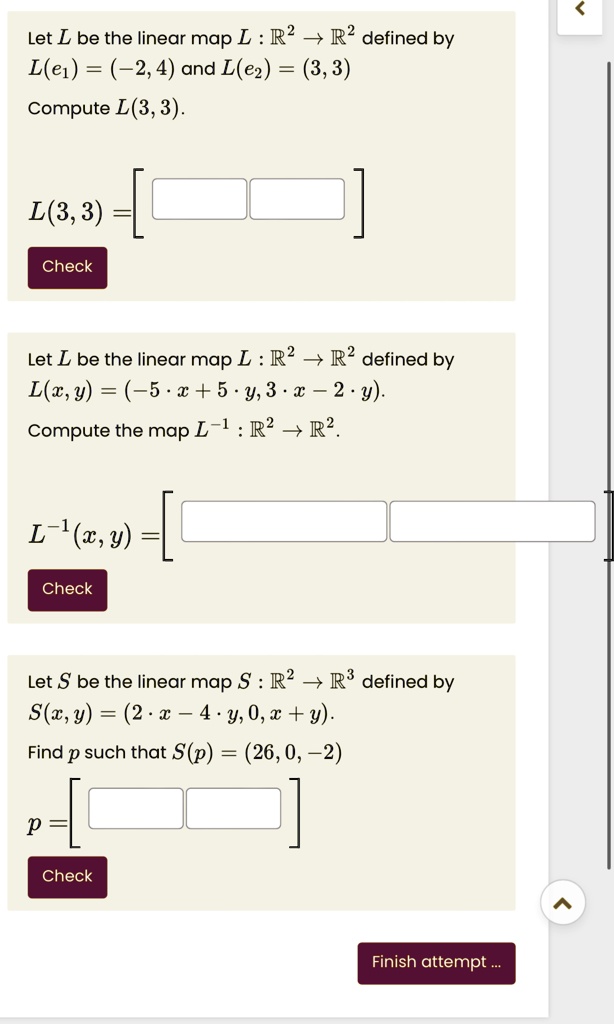
Let L be the linear map $L: \mathbb{R}^2 \rightarrow \mathbb{R}^2$ defined by
$L(e_1) = (-2, 4)$ and $L(e_2) = (3, 3)$
Compute $L(3, 3)$.
$L(3, 3) = \[\]$
Check
Let L be the linear map $L: \mathbb{R}^2 \rightarrow \mathbb{R}^2$ defined by
$L(x, y) = (-5 \cdot x + 5 \cdot y, 3 \cdot x - 2 \cdot y)$.
Compute the map $L^{-1}: \mathbb{R}^2 \rightarrow \mathbb{R}^2$.
$L^{-1}(x, y) = \[\]$
Check
Let S be the linear map $S: \mathbb{R}^2 \rightarrow \mathbb{R}^3$ defined by
$S(x, y) = (2 \cdot x - 4 \cdot y, 0, x + y)$.
Find $p$ such that $S(p) = (26, 0, -2)$
$p = \[\]$
Check
Finish attempt ...