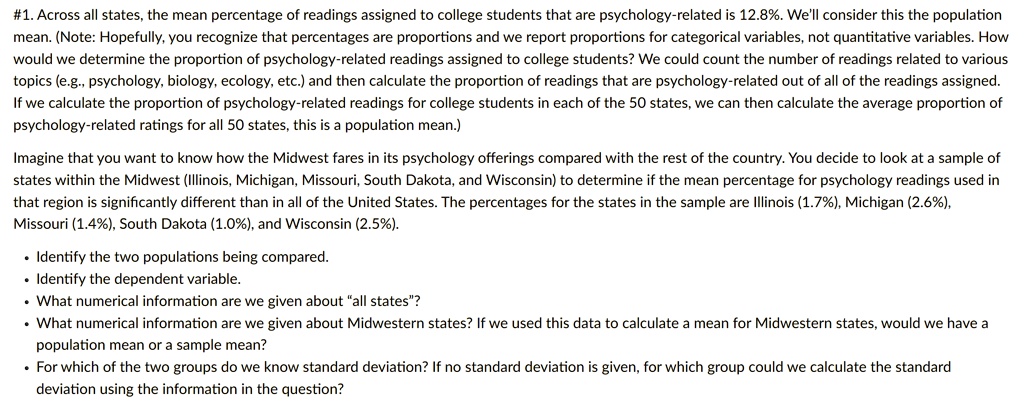
1. Across all states, the mean percentage of readings assigned to college students that are psychology-related is 12.8%. We'll consider this the population mean. (Note: Hopefully, you recognize that percentages are proportions and we report proportions for categorical variables, not quantitative variables. How would we determine the proportion of psychology-related readings assigned to college students? We could count the number of readings related to various topics (e.g., psychology, biology, ecology, etc.) and then calculate the proportion of readings that are psychology-related out of all of the readings assigned. If we calculate the proportion of psychology-related readings for college students in each of the 50 states, we can then calculate the average proportion of psychology-related ratings for all 50 states, this is a population mean.) Imagine that you want to know how the Midwest fares in its psychology offerings compared with the rest of the country. You decide to look at a sample of states within the Midwest (Illinois, Michigan, Missouri, South Dakota, and Wisconsin) to determine if the mean percentage for psychology readings used in that region is significantly different than in all of the United States. The percentages for the states in the sample are Illinois (1.7%), Michigan (2.6%), Missouri (1.4%), South Dakota (1.0%), and Wisconsin (2.5%). \ Identify the two populations being compared. \ Identify the dependent variable. \ What numerical information are we given about \"all states\"? \ What numerical information are we given about Midwestern states? If we used this data to calculate a mean for Midwestern states, would we have a population mean or a sample mean? \ For which of the two groups do we know standard deviation? If no standard deviation is given, for which group could we calculate the standard deviation using the information in the question?