Workshop 9: Molecular Orbital (MO) Energy Diagrams
Molecular Orbital Theory is a theory of bonding that helps us predict how 2 atomic orbitals can combine to create 2 new orbitals called molecular orbitals (one bonding and one antibonding MO's). In topic 12 we looked mostly at homonuclear molecules like H$_2$, F$_2$, and N$_2$, but MO theory can also be used to explain the bonding in heteronuclear molecules or ions like HF, CO, and NO. In these molecules the atomic orbitals to be combined are at different energy levels. In the case of heteronuclear molecules atomic orbitals that are close in energy will overlap - and these orbitals do not necessarily have to be of the same shell nor do they have to be of the same type.
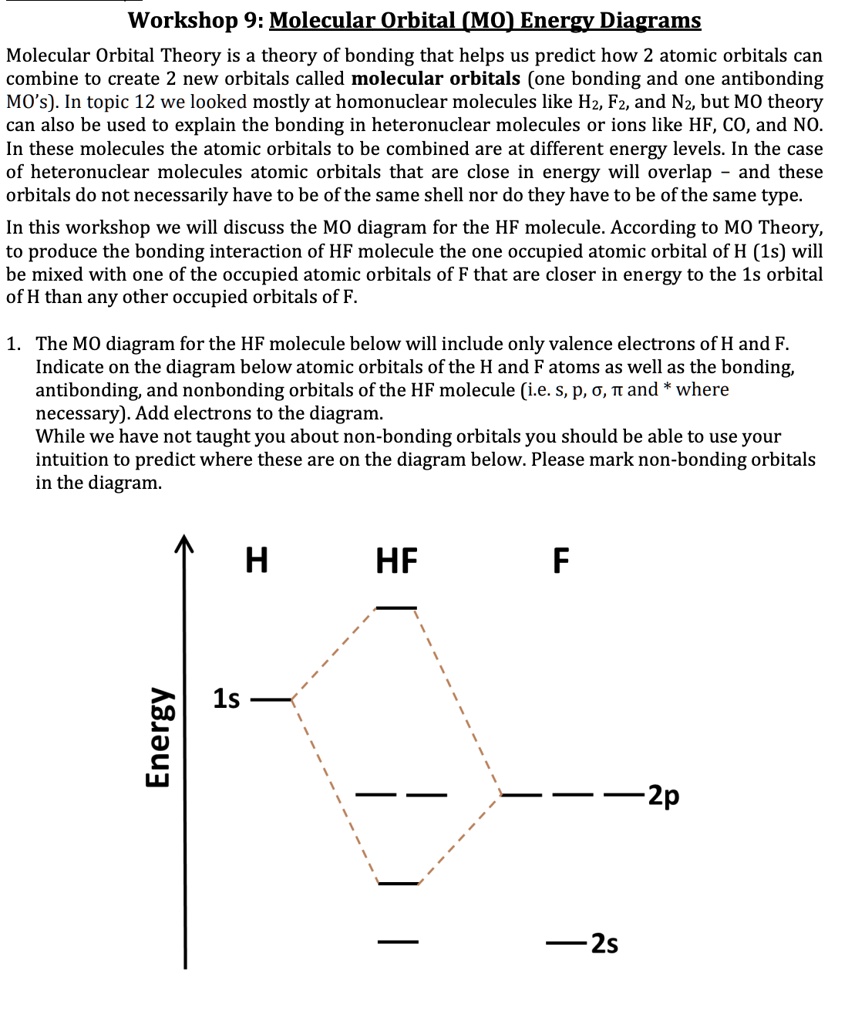
In this workshop we will discuss the MO diagram for the HF molecule. According to MO Theory, to produce the bonding interaction of HF molecule the one occupied atomic orbital of H (1s) will be mixed with one of the occupied atomic orbitals of F that are closer in energy to the 1s orbital of H than any other occupied orbitals of F.
1. The MO diagram for the HF molecule below will include only valence electrons of H and F. Indicate on the diagram below atomic orbitals of the H and F atoms as well as the bonding, antibonding, and nonbonding orbitals of the HF molecule (i.e. s, p, $\sigma$, $\pi$ and * where necessary). Add electrons to the diagram. While we have not taught you about non-bonding orbitals you should be able to use your intuition to predict where these are on the diagram below. Please mark non-bonding orbitals in the diagram.
Energy
1s
H
HF
F
2s
-2p