Ace - AI Tutor
Ask Our Educators
Textbooks
My Library
Flashcards
Scribe - AI Notes
Notes & Exams
Download App
lorenzo maldonado

lorenzo m.

Divider

Questions asked

BEST MATCH

Which of these species does not have a trigonal pyramidal shape? Question 1 options: NCl3 BF3 H3O+ PH3

View Answer
divider
BEST MATCH

When potassium begins flowing through open voltage-gated channels the membrane Multiple Choice depolarizes. hyperpolarizes. repolarizes. reaches resting potential.

View Answer
divider
BEST MATCH

Knowledge Check each relation, decide whether or not it is a function. Relation 1 Domain Range leaf 8 desk 4 pen -4 lake -3 • Function Not a function

View Answer
divider
BEST MATCH

What advice would you give to your peers, grandparents, parents, etc about how to spot pseudoscience

View Answer
divider
BEST MATCH

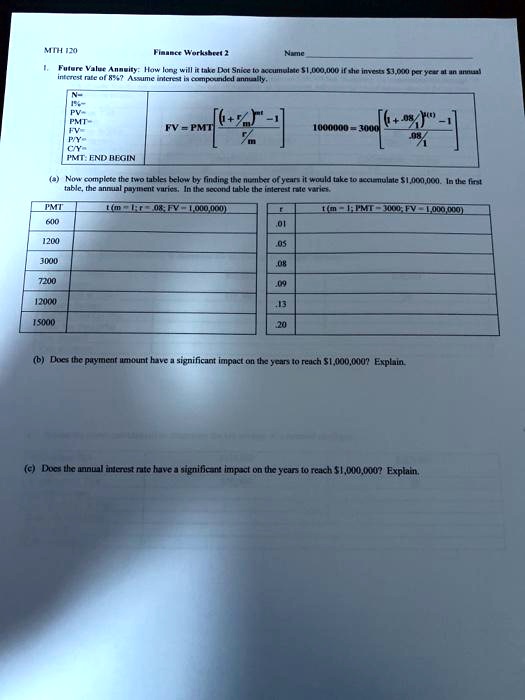
MTH 120 Finance Worksheet 2 Name 1. Future Value Annuity: How long will it take Dot Snice to accumulate $1,000,000 if she invests $3,000 per year at an annual interest rate of 8%? Assume interest is compounded annually. N-\1%-PV-\PMT-\FV-\P/Y-\C/Y-\PMT: END BEGIN $1000000 = 3000 \left[ \frac{(1 + \frac{.08}{m})^{mt} - 1}{\frac{.08}{m}} \right] (a) Now complete the two tables below by finding the number of years it would take to accumulate $1,000,000. In the first table, the annual payment varies. In the second table the interest rate varies. PMT t (m = 1; r = .08; FV = 1,000,000) r t (m = 1; PMT = 3000; FV = 1,000,000) 600 .01 1200 .05 3000 .08 7200 .09 12000 .13 15000 .20 (b) Does the payment amount have a significant impact on the years to reach $1,000,000? Explain. (c) Does the annual interest rate have a significant impact on the years to reach $1,000,000? Explain.
View Answer
divider
BEST MATCH

Chapter 25: The Digestive System Name: Date: Section: The text corresponds to the Learning Objective(s) listed in the chapter opener outline "Do You Know the Basics?" Exercise 25.1: Histology of the Salivary Glands 1. The cells within salivary glands that produce salivary amylase are (mucous/serous) cells. Her cheek, as one of her salivary glands, emitted its secretions into her mouth. Which of the three pairs of salivary glands did she feel? (Circle one.) a. parotid b. sublingual c. submandibular Exercise 25.2: Wall Layers of the Stomach 3. Place the layers of the stomach wall in the correct order, from innermost to outermost. a. mucosa b. submucosa c. muscularis d. serosa 4. The stomach contains (two/three) layers of smooth muscle in its muscularis layer. 5. The mucosa of the stomach is lined with simple columnar/cuboidal epithelial tissue. Exercise 25.3: Histology of the Stomach 6. In the cardia of the stomach, gastric pits are (short/long), whereas gastric glands are (short/long). 7. Mucous neck cells are found in gastric glands/pits. Exercise 25.4: Histology of the Small Intestine 8. Which of the following structure(s) increase(s) the total surface area of the small intestine? (Check all that apply) a. circular folds b. microvilli c. villi (Goblet/Transitional) cells in the small intestine produce mucus, which protects and lubricates the epithelium of the small intestine. 10. The presence of Peyer patches is unique to the ileum. True/False Exercise 25.5: Histology of the Large Intestine 11. Which of the following is the epithelial modification that is particularly abundant in the large intestine? (Circle one.) a. circular folds b. goblet cells c. microvilli d. submucosal glands 12. Place the wall layers of the large intestine in order from innermost to outermost. a. mucosa b. submucosa c. muscularis mucosa d. muscularis e. serosa Chapter Twenty-Five: The Digestive System

View Answer
divider
BEST MATCH

18. [0/1 Points] DETAILS PREVIOUS ANSWERS SERCP11GE 2.P.046. MY NOTES ASK YOUR TEACHER PRACTICE ANOTHER A ball is thrown directly downward with an initial speed of 8.60 m/s, from a height of 29.8 m. After what time interval does it strike the ground? Your response differs from the correct answer by more than 10%. Double check your calculations. s Need Help? eBook Watch It Submit Answer

View Answer
divider
BEST MATCH

1. A 125.0 g sample of a metal initially at a temperature of 825 K, is dropped into 1.00 L of water that is at 25.0 °C. The temperature of the water rises from 25.0 °C to 36.9°C. Given that the heat capacity of the water is 4.184 J g$^{-1}$ K$^{-1}$, calculate the heat capacity of the metal. (5 marks)

View Answer
divider
BEST MATCH

5. Consider the logic equation Y = NOT. (A \cdot B + (C + D + E)). a. Sketch the circuit using Complementary CMOS design (10%) b. Sketch the circuit using Pseudo-NMOS realization of the logic equation. (10%) c. Sketch the circuit using Dynamic logic (10%)

View Answer
divider
BEST MATCH

Plot the points for the energy versus time that are separated by the step t = 0.5 ms. The current through a 0.5- capacitor is shown in the figure. At t = 0, the voltage is zero. (Figure 1) 900o No elements selected (t)(mJ) 2.0 1.5 * 1.0 0.5 Figure <1 of 1> (ms) 3.5 4.0 4.5 5.0 1.0 1.5 2.0 2.5 3.0 i(r) (mA) the main menu. v(n) (a) (b) Submit Request Answer

View Answer
divider