Ace - AI Tutor
Ask Our Educators
Textbooks
My Library
Flashcards
Scribe - AI Notes
Notes & Exams
Download App
lorenzo valenzuela

lorenzo v.

Divider

Questions asked

BEST MATCH

Solve: $3|x - 2| + 2 \leq 17$. Give your answer as an interval.

View Answer
divider
BEST MATCH

b) state the 20th term: I (enter a number) c) give a formula for the nth term: (enter a formula as you would type it in a calculator, such as 2x 1,4,9,16,

View Answer
divider
BEST MATCH

Given the open-loop transfer function of a unity feedback system: $$G(s) = \frac{1}{4s^2(s^2+2)}$$ Tasks: (a) Find the closed-loop characteristic equation (b) Use MATLAB to build the Routh table of the closed-loop system. (c) Identify the location of closed-loop poles (RHP, LHP, or jω-axis). (d) Determine if the system is stable, marginally stable, or unstable.

View Answer
divider
BEST MATCH

26. Maximum Area Find the dimensions of the largest rectangle that can be inscribed in a semicircle of radius \( r \) (see Exercise 25).

View Answer
divider
BEST MATCH

Q1. Starting from \(\mathbf{n} = \mathbf{W}\mathbf{n} + \mathbf{D}\mathbf{n} - (\mathbf{D}\mathbf{n} \cdot \mathbf{n})\mathbf{n}\) where, \(\mathbf{n}\) is the unit vector in the direction of the deformed material filament originally in the direction N. Show that: a) Show that the rate of shear between two filaments is given by: \( -\sin(\theta)\dot{\theta} = 2\mathbf{D}\mathbf{n}_1 \cdot \mathbf{n}_2 + (\mathbf{n}_1 \cdot \mathbf{n}_2)(-\mathbf{D}\mathbf{n}_1 \cdot \mathbf{n}_1 - \mathbf{D}\mathbf{n}_1 \cdot \mathbf{n}_1) \) (1) b) Hence conclude that the off-diagonal components of D capture the rate of shear. c) Also, from this show that filaments along the eigenvector directions of D rotate rigidly.

View Answer
divider
BEST MATCH

$\qquad\qquad\qquad N_1$ $\qquad L_{m1}\qquad N_2$ $V_i\qquad +\quad -$ $\qquad\qquad L_{m2}$

View Answer
divider
BEST MATCH

Express the following repeating decimal number as a ratio of two integers: \overline{1.414} = 1.414414414...

View Answer
divider
BEST MATCH

4. Calculate the following integral. Draw and label a diagram showing the contour of integration and the singularities. $I = \int_0^{2\pi} \frac{1}{\cos(\theta) + \sin(\theta) + \frac{3}{2}} d\theta$.

View Answer
divider
BEST MATCH

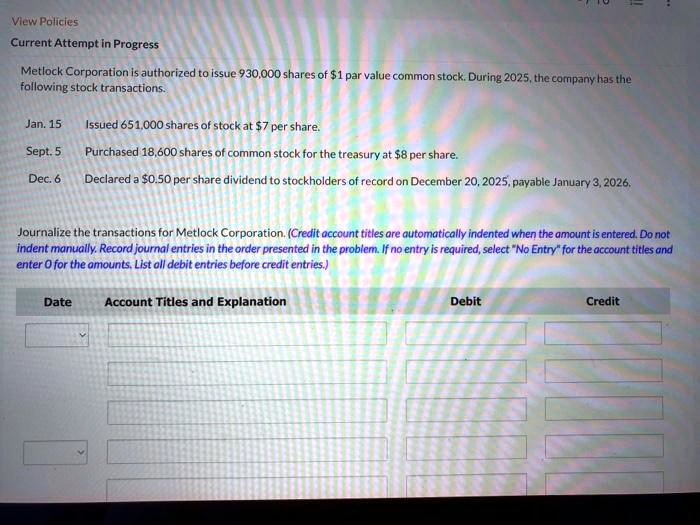
View Policies Current Attempt in Progress Metlock Corporation is authorized to issue 930,000 shares of $1 par value common stock. During 2025, the company has the following stock transactions. Jan. 15 Issued 651,000 shares of stock at $7 per share. Sept. 5 Purchased 18,600 shares of common stock for the treasury at $8 per share. Dec. 6 Declared a $0.50 per share dividend to stockholders of record on December 20, 2025, payable January 3, 2026. Journalize the transactions for Metlock Corporation. (Credit account titles are automatically indented when the amount is entered. Do not indent manually. Record journal entries in the order presented in the problem. If no entry is required, select \"No Entry\" for the account titles and enter 0 for the amounts. List all debit entries before credit entries.) Date Account Titles and Explanation Debit Credit
View Answer
divider
BEST MATCH

Q1. (20P) Set up the mathematical formulation of the following heat conduction problems. Formulation includes the simplified differential heat equation along with boundary and initial conditions. Do not solve the problems. a) A slab in $0 \le x \le L$ is initially at a temperature g(x). For times t > 0, the boundary at x = 0 is kept insulated, and the boundary at x = L dissipates heat by convection into a medium at $T_\infty$. temperature b) A semi-infinite region $0 \le x \le \infty$ initially at a temperature f(x). For time t > 0, heat is generated in the medium at a constant uniform rate of $q_0$ (W/m³), while the boundary at x = 0 is kept at zero temperature. c) A hollow cylinder $a \le r \le b$ is initially at a temperature f(r). For times t > 0, heat is generated within the medium at a rate of $q_0$ (W/m³), while both the inner boundary at r = a and outer boundary r = b dissipate heat by convection into medium at fluid temperature $T_\infty$.

View Answer
divider