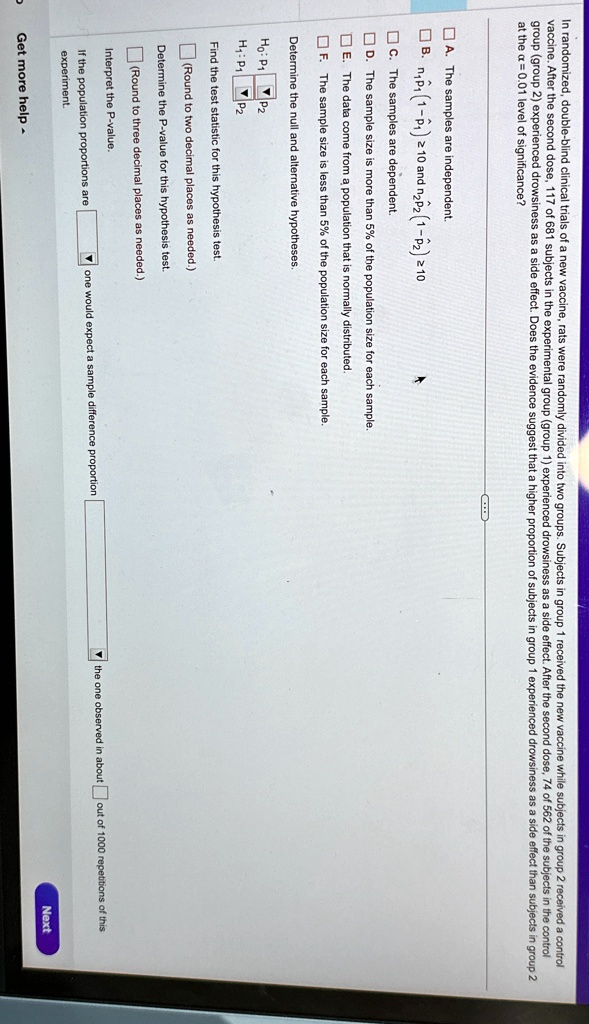
In randomized, double-blind clinical trials of a new vaccine, rats were randomly divided into two groups. Subjects in group 1 received the new vaccine while subjects in group 2 received a control vaccine. After the second dose, 117 of 681 subjects in the experimental group (group 1) experienced drowsiness as a side effect. After the second dose, 74 of 562 of the subjects in the control group (group 2) experienced drowsiness as a side effect. Does the evidence suggest that a higher proportion of subjects in group 1 experienced drowsiness as a side effect than subjects in group 2 at the x = 0.01 level of significance?
A. The samples are independent.
B. $n_1\hat{p}_1(1-\hat{p}_1) \ge 10$ and $n_2\hat{p}_2(1-\hat{p}_2) \ge 10$
C. The samples are dependent.
D. The sample size is more than 5% of the population size for each sample.
E. The data come from a population that is normally distributed.
F. The sample size is less than 5% of the population size for each sample.
Determine the null and alternative hypotheses.
$H_0: p_1 \le p_2$
$H_1: p_1 > p_2$
Find the test statistic for this hypothesis test.
(Round to two decimal places as needed.)
Determine the P-value for this hypothesis test.
(Round to three decimal places as needed.)
Interpret the P-value.
If the population proportions are
one would expect a sample difference proportion
the one observed in about out of 1000 repetitions of this experiment.