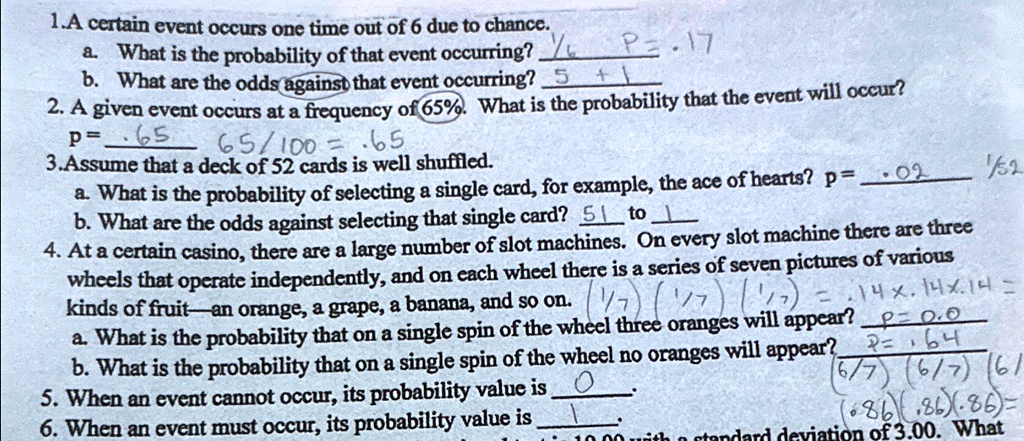
1.A certain event occurs one time out of 6 due to chance.
a. What is the probability of that event occurring? \frac{1}{6} P=.17
b. What are the odds against that event occurring? \frac{5}{1} + 1
2. A given event occurs at a frequency of 65%. What is the probability that the event will occur?
p= .65 \quad \frac{65}{100} = .65
3. Assume that a deck of 52 cards is well shuffled.
a. What is the probability of selecting a single card, for example, the ace of hearts? p= .02 \frac{1}{52}
b. What are the odds against selecting that single card? \frac{51}{1} to 1
4. At a certain casino, there are a large number of slot machines. On every slot machine there are three
wheels that operate independently, and on each wheel there is a series of seven pictures of various
kinds of fruit—an orange, a grape, a banana, and so on.
(\frac{1}{7})(\frac{1}{7})(\frac{1}{7}) = .14 \times .14 \times .14 =
a. What is the probability that on a single spin of the wheel three oranges will appear? P=0.0
b. What is the probability that on a single spin of the wheel no oranges will appear?
\frac{P = .64}{(\frac{6}{7})(\frac{6}{7})(\frac{6}{7})}
(\frac{6}{7})(\frac{6}{7})(\frac{6}{7})
5. When an event cannot occur, its probability value is 0
6. When an event must occur, its probability value is 1