Problem: Electric Field Due to a Line of Charge
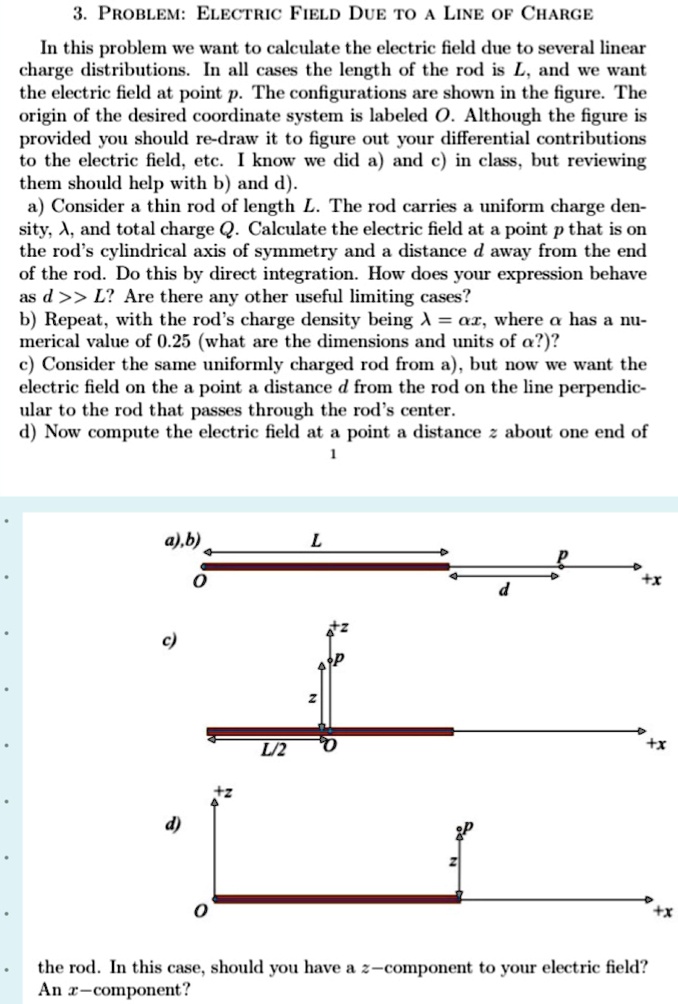
In this problem we want to calculate the electric field due to several linear charge distributions. In all cases the length of the rod is L, and we want the electric field at point p. The configurations are shown in the figure. The origin of the desired coordinate system is labeled O. Although the figure is provided you should re-draw it to figure out your differential contributions to the electric field, etc. I know we did a) and c) in class, but reviewing them should help with b) and d).
a) Consider a thin rod of length L. The rod carries a uniform charge density, lambda , and total charge Q. Calculate the electric field at a point p that is on the rod's cylindrical axis of symmetry and a distance d away from the end of the rod. Do this by direct integration. How does your expression behave as d>>L ? Are there any other useful limiting cases?
b) Repeat, with the rod's charge density being lambda =alpha x, where alpha has a numerical value of 0.25 (what are the dimensions and units of alpha ?)?
c) Consider the same uniformly charged rod from a), but now we want the electric field on the a point a distance d from the rod on the line perpendicular to the rod that passes through the rod's center.
d) Now compute the electric field at a point a distance z about one end of 1
a),b)
c)
the rod. In this case, should you have a z-component to your electric field?
An x-component?
3.PROBLEM: ELECTRIC FIELD DUE TO A LINE OF CHARGE
In this problem we want to calculate the electric field due to several linear charge distributions. In all cases the length of the rod is L. and we want the electric field at point p. The configurations are shown in the figure. The origin of the desired coordinate system is labeled O. Although the figure is provided you should re-draw it to figure out your differential contributions to the electric field, etc. I know we did a and c in class, but reviewing them should help with b) and d) a Consider a thin rod of length L. The rod carries a uniform charge den- sity,A,and total charge Q.Calculate the electric field at a point p that is on the rod's cylindrical axis of symmetry and a distance d away from the end of the rod. Do this by direct integration. How does your expression behave as d >> L? Are there any other useful limiting cases? b Repeat,with the rod's charge density being = a, where has a nu- merical value of 0.25(what are the dimensions and units of a?? c Consider the same uniformly charged rod from a,but now we want the electric field on the a point a distance d from the rod on the line perpendic- ular to the rod that passes through the rod's center d Now compute the electric field at a point a distance z about one end of
-
a),b)
L
P
0
c
L/2
+x
d)
the rod.In this case,should you have a z-component to your electric field? An x-component?