Texts: Discrete Mathematics
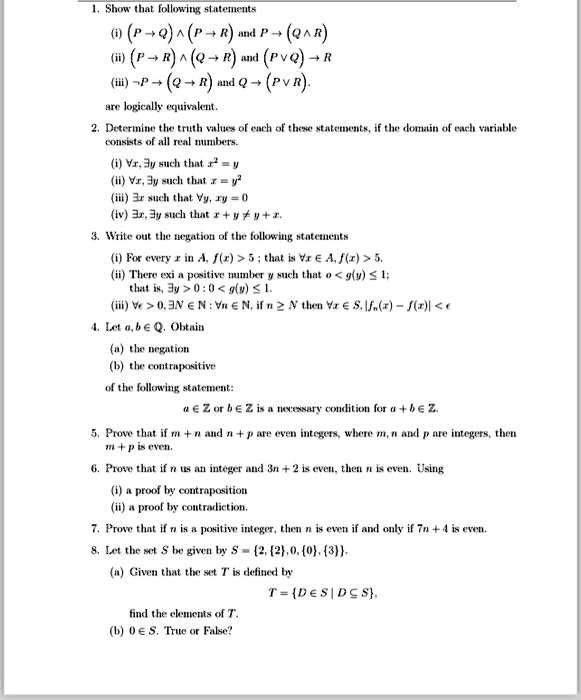
1. Show that the following statements are logically equivalent:
i) P ∧ (P → Q) ↔ R ∧ (P ∨ R)
ii) ¬(Q ∧ R) ↔ (P ∧ (Q ∨ R))
2. Determine the truth values of each of these statements, if the domain of each variable consists of all real numbers:
i) ∃x ∀y (x = y)
ii) ∀x ∃y (x = y)
iii) ¬(0 < f(x)) ∨ (q(x) ∧ s(E))
3. Write out the negation of the following statements:
i) For every x in A, f(x) > 5.
ii) There exists a positive number y such that 0 < g(y) ≤ 1.
iii) If n is a natural number, then for every x such that n ≤ x, f(n) ≤ f(x).
4. Let a, b, and c be real numbers. Obtain:
a) The negation of the statement: "a is a necessary condition for a + b = c."
b) The contrapositive of the statement: "If a is not an integer or b is not an integer, then a + b is not an integer."
5. Prove that if m + n and n + p are even integers, where m, n, and p are integers, then m + p is an even integer.
6. Prove that if n is an integer and 3n + 2 is even, then n is even using:
i) A proof by contraposition.
ii) A proof by contradiction.
7. Prove that if n is a positive integer, then n is even if and only if 7n + 4 is even.
8. Let the set S be given by S = {2, {2}, 0, {0}, {3}}.
a) Given that the set T is defined by T = {D | D ∈ S}, find the elements of T.
b) Is 0 an element of S? True or False?