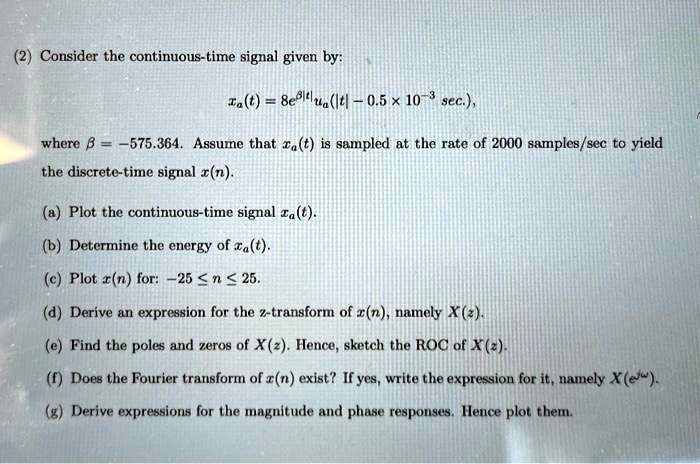
(2) Consider the continuous-time signal given by:
$x_a(t) = 8e^{\beta t}u_a(t - 0.5 \times 10^{-3} \text{ sec.})$,
where $\beta = -575.364$. Assume that $x_a(t)$ is sampled at the rate of 2000 samples/sec to yield
the discrete-time signal $x(n)$.
(a) Plot the continuous-time signal $x_a(t)$.
(b) Determine the energy of $x_a(t)$.
(c) Plot $x(n)$ for: $-25 \le n \le 25$.
(d) Derive an expression for the z-transform of $x(n)$, namely $X(z)$.
(e) Find the poles and zeros of $X(z)$. Hence, sketch the ROC of $X(z)$.
(f) Does the Fourier transform of $x(n)$ exist? If yes, write the expression for it, namely $X(e^{j\omega})$.
(g) Derive expressions for the magnitude and phase responses. Hence plot them.