Questions asked
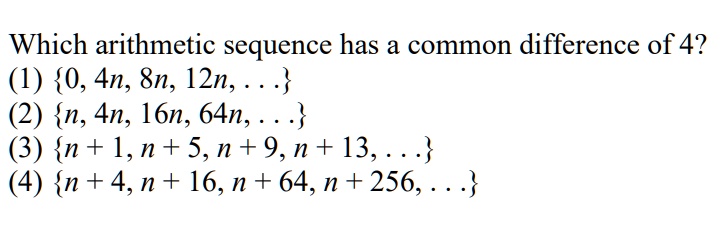
Which arithmetic sequence has a common difference of 4? (1) {$0, 4n, 8n, 12n, \dots$} (2) {$n, 4n, 16n, 64n, \dots$} (3) {$n + 1, n + 5, n + 9, n + 13, \dots$} (4) {$n + 4, n + 16, n + 64, n + 256, \dots$}
For the circuit shown below: AC input= 120V rms, 60Hz. Transformer Ratio = 12:1. Reference Voltage = 8.7V. R load = 51 Ohms. Ambient temperature = 60 degrees C. Transistor is a TIP31. There is no heatsink on the transistor. What is the value of the Regulated Output voltage?
Which of Jupiter's four largest moons has the longest orbital period?
9. Which of the following cities is Canada's largest employment hub? O Ottawa O Montreal O Vancouver O Halifax O Toronto
10. The picture of an isotope is given, write the nuclear notation and write the name of the isotope.
Should we spend tax dollars to support scientists or researchers in their investigation to solve the problem
In part a of the figure, shaft a is attached to the planet carrier, shaft b is keyed to sun gear 5, and sun gear 2 is fixed to the housing. Planet gears 3 and 4 are attached to each other. Shaft a is driven at 800 rpm ccw; find the speed and direction of rotation of shaft b.
9) The tables below are a section extracted from a partially filled MTM analysis form for the operations \"staple papers\" and \"t-shirt turning\". Find the appropriate codes for the left and right hands and calculate the total time in TMU's. The information provided for each hand is sufficient to determine the appropriate code. Do not make assumptions. Calculate the standard time if the rating average is 110% and the allowances are 22% LH Description Reach Stapler Machine (19", B case, hand in motion) Turn 90°, empty hand Grasp stapler (contact grasp) Apply pressure (Apply force, dwell minimum, and release force) Move down stapler (1/2", A case) Release stapler (contact release) TOTAL LH Motion TMU RH Motion RH Description Move papers to stapler (17", case B) Position papers (loose fit, semi-symmetrical, easy to handle) Move papers back (6", B case, hand in motion)
[Select] refers to the case when people engage in riskier behavior with insurance than they would if they did [Select] Moral hazard Adverse selection [Select] happens when insurance buyers have more information about whether they are high-risk or low-risk than the insurance company does. Hence, a good example would be [Select] [Select] are ways to reduce the moral hazard problem, whereas to reduce adverse selection [Select]
1) What is concept selection? What methods would you use for concept selection? 2) What are the two design axioms? Explain the implications of each. 3) What is a system model? Give examples of different kinds of system models. 4) How will you distinguish between a good and a bad decision? Do you agree with this distinction? 5) Your friend provides the following rank order of six preferences (">" means "is preferred to" and "=" means "is as preferable as"). Is she consistent with the order rule? Why? (a) A > B > C > E = F = D (b) A > B, C = E, C > B, F = D (c) A > B = C > D = E > F (d) A = B > C < E = F < D = A (e) A > B > C, E > F > D, B > F