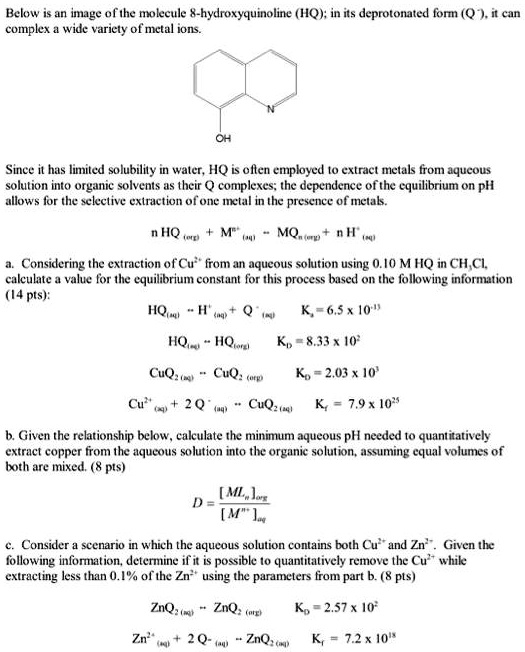
Below is an image of the molecule 8-hydroxyquinoline (HQ); in its deprotonated form (Q), it can
complex a wide variety of metal ions.
OH
Since it has limited solubility in water, HQ is often employed to extract metals from aqueous
solution into organic solvents as their Q complexes; the dependence of the equilibrium on pH
allows for the selective extraction of one metal in the presence of metals.
n HQ$_{(org)}$ + M$^{n+}_{(aq)}$ -- MQ$_n$$_{(org)}$ + nH$_{(aq)}$
a. Considering the extraction of Cu$^{2+}$ from an aqueous solution using 0.10 M HQ in CH$_2$Cl$_2$,
calculate a value for the equilibrium constant for this process based on the following information
(14 pts):
HQ$_{(aq)}$ -- H$_{(aq)}$ + Q$_{(aq)}$ K$_a$ = 6.5 x 10$^{-11}$
HQ$_{(aq)}$ -- HQ$_{(org)}$ K$_D$ = 8.33 x 10$^2$
CuQ$_2$$_{(aq)}$ -- CuQ$_2$$_{(org)}$ K$_D$ = 2.03 x 10$^3$
Cu$^{2+}_{(aq)}$ + 2Q$_{(aq)}$ -- CuQ$_2$$_{(aq)}$ K$_f$ = 7.9 x 10$^{25}$
b. Given the relationship below, calculate the minimum aqueous pH needed to quantitatively
extract copper from the aqueous solution into the organic solution, assuming equal volumes of
both are mixed. (8 pts)
$D = \frac{[ML]_{org}}{[M]_{aq}}$
c. Consider a scenario in which the aqueous solution contains both Cu$^{2+}$ and Zn$^{2+}$. Given the
following information, determine if it is possible to quantitatively remove the Cu$^{2+}$ while
extracting less than 0.1% of the Zn$^{2+}$ using the parameters from part b. (8 pts)
ZnQ$_2$$_{(aq)}$ -- ZnQ$_2$$_{(org)}$ K$_D$ = 2.57 x 10$^8$
Zn$^{2+}_{(aq)}$ + 2Q$_{(aq)}$ -- ZnQ$_2$$_{(aq)}$ K$_f$ = 7.2 x 10$^{18}$