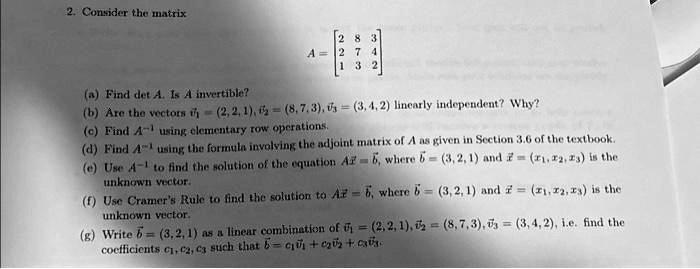
2. Consider the matrix
\begin{equation*}
A = \begin{bmatrix} 2 & 8 & 3 \\ 2 & 7 & 4 \\ 1 & 3 & 2 \end{bmatrix}
\end{equation*}
(a) Find det A. Is A invertible?
(b) Are the vectors $\vec{v}_1 = (2, 2, 1)$, $\vec{v}_2 = (8, 7, 3)$, $\vec{v}_3 = (3, 4, 2)$ linearly independent? Why?
(c) Find $A^{-1}$ using elementary row operations.
(d) Find $A^{-1}$ using the formula involving the adjoint matrix of A as given in Section 3.6 of the textbook.
(e) Use $A^{-1}$ to find the solution of the equation $A\vec{x} = \vec{b}$, where $\vec{b} = (3, 2, 1)$ and $\vec{x} = (x_1, x_2, x_3)$ is the
unknown vector.
(f) Use Cramer's Rule to find the solution to $A\vec{x} = \vec{b}$, where $\vec{b} = (3, 2, 1)$ and $\vec{x} = (x_1, x_2, x_3)$ is the
unknown vector.
(g) Write $\vec{b} = (3, 2, 1)$ as a linear combination of $\vec{v}_1 = (2, 2, 1)$, $\vec{v}_2 = (8, 7, 3)$, $\vec{v}_3 = (3, 4, 2)$, i.e. find the
coefficients $c_1, c_2, c_3$ such that $\vec{b} = c_1\vec{v}_1 + c_2\vec{v}_2 + c_3\vec{v}_3$