Question 1
A spherical snowball is melting in such a way that its diameter is decreasing at a rate of 0.3 cm/min. At what rate is the volume of the snowball decreasing when the diameter is 9 cm?
Question 2
Radar guns are often used by police officers to measure the rate of change in distance between the gun and the object it is measuring. For instance, a reading of "55 mph" means the object is moving away from the gun at a rate of 55 miles per hour, whereas a measurement of "-25 mph" would mean that the object is approaching the gun at a rate of 25 miles per hour.
If the radar gun is moving, then radar readouts are only immediately understandable if the gun and the object are moving along the same line. If a police officer is traveling 60 mph and gets a readout of 15 mph, the officer knows that the car ahead is moving away at a rate of 15 miles an hour, which means that the car is traveling 75 mph. (This straight-line principle is one reason why officers park on the side of the highway and try to shoot straight back down the road. It gives the most accurate reading.)
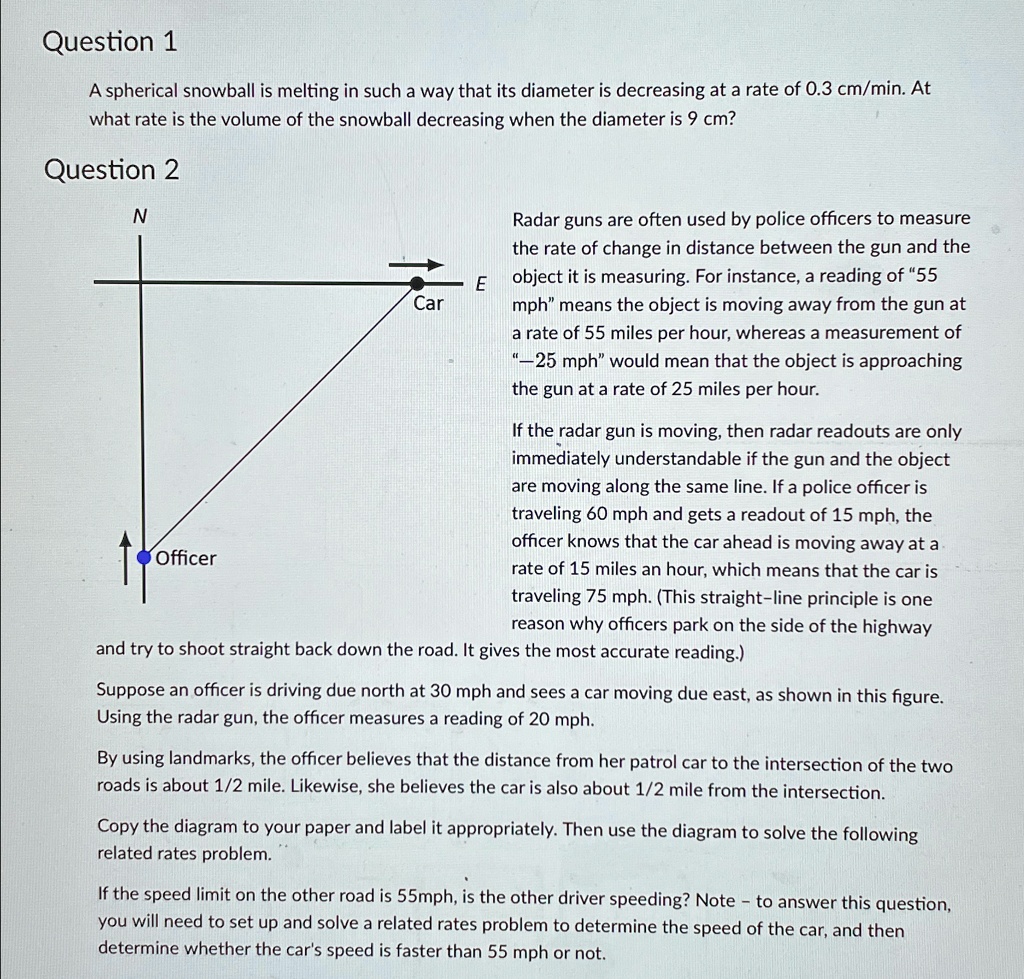
Suppose an officer is driving due north at 30 mph and sees a car moving due east, as shown in this figure. Using the radar gun, the officer measures a reading of 20 mph.
By using landmarks, the officer believes that the distance from her patrol car to the intersection of the two roads is about 1/2 mile. Likewise, she believes the car is also about 1/2 mile from the intersection. Copy the diagram to your paper and label it appropriately. Then use the diagram to solve the following related rates problem.
If the speed limit on the other road is 55 mph, is the other driver speeding? Note - to answer this question, you will need to set up and solve a related rates problem to determine the speed of the car, and then determine whether the car's speed is faster than 55 mph or not.