Ace - AI Tutor
Ask Our Educators
Textbooks
My Library
Flashcards
Scribe - AI Notes
Notes & Exams
Download App
luis miguel morales

luis miguel m.

Divider

Questions asked

BEST MATCH

The number of items is modeled by h(x) = 0.42x2 + 0.3x + 4, and the cost per item is modeled by r(x) = −0.005x2 − 0.2x + 7. The total cost is the product of the number of items and the cost per item. Identify a polynomial q(x) that can be used to model the total cost.

View Answer
divider
BEST MATCH

4. ____ is a reasonable rate of return established for the evaluation and selection of alternatives. An engineering project is not considered economically viable unless this is met (also referred to as hurdle rate or benchmark rate).

View Answer
divider
BEST MATCH

(a) p ∧ p. (b) (∼ p) ∧ (∼ q). (c) ∼ (p ∨ q). (d) (∼ p) ∨ q. (e) p ∧ (∼ q). (f) (∼ p) ∧ q. (g) p ∨ (∼ q). (h) p ∧ (q ∧ r). (i) (p ∧ q) ∨ (p ∧ r). (j) p ∨ (q ∨ r). (k) p ∨ (q ∧ r). (l) (p ∨ q) ∧ (p ∨ r).

View Answer
divider
BEST MATCH

29. \( \cos (x-y)+\sin y=\sqrt{2} \); \( \left(\frac{\pi}{2}, \frac{\pi}{4}\right) \) 30. \( \left(x^{2}+y^{2}\right)^{2}=\frac{25}{4} x y^{2} \); \( (1,2) \)

View Answer
divider
BEST MATCH

A _____________ attack attempts to prevent a client from successfully negotiating robust high-grade encryption with a server. Group of answer choices Downgrade Birthday Collision Virus

View Answer
divider
BEST MATCH

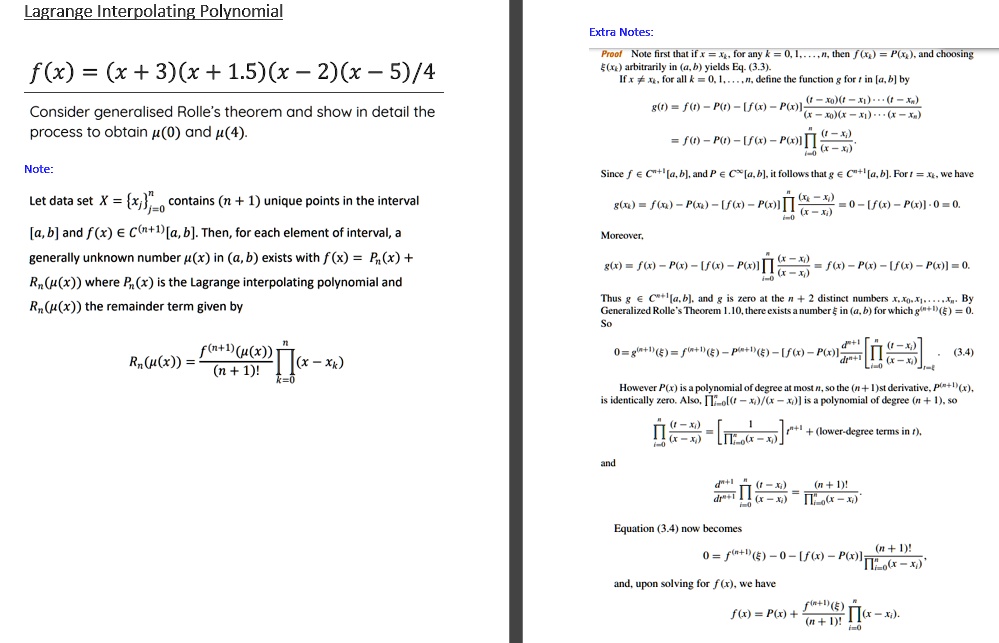
f(x) = (x + 3)(x + 1.5)(x - 2)(x - 5)/4 Consider generalized Rolle's theorem and show in detail the process to obtain μ(0) and μ(4). Note: Let data set x = {x_j}_(j)=0^(n) contains (n + 1) unique points in the interval [a, b] and f(x) in C^((n+1))[a, b]. Then, for each element of the interval, a generally unknown number μ(x) in (a, b) exists with f(x) = P_(n)(x) + R_(n)(μ(x)) where P_(n)(x) is the Lagrange interpolating polynomial and R_(n)(μ(x)) the remainder term given by R_(n)(μ(x)) = (f^((n+1))(μ(x)))/((n + 1)!)prod_(k)=0^(n)(x - x_(k)) Extra Notes: Proof Note first that if x = x_(k), for any k = 0, 1, ..., n, then f(x_(k)) = P(x_(k)), and choosing μ(x_(k)) arbitrarily in (a, b) yields Eq. (3.3). If x ≠ x_(k), for all k = 0, 1, ..., n, define the function g for t in [a, b] by g(t) = f(t) - P(t) - [f(x) - P(x)]((t - x_(0))(t - x_(1))⋯(t - x_(n)))/((x - x_(0))(x - x_(1))⋯(x - x_(n))) = f(t) - P(t) - [f(x) - P(x)]prod_(i)=0^(n)((t - x_(j)))/((x - x_(i))). Since f in C^(n+1)[a, b], and P in C^∞[a, b], it follows that g in C^(n+1)[a, b]. For t = x_(k), we have g(x_(k)) = f(x_(k)) - P(x_(k)) - [f(x) - P(x)]prod_(i)=0^(n)((x_(k) - x_(i)))/((x - x_(i))) = 0 - [f(x) - P(x)] * 0 = 0. Moreover, g(x) = f(x) - P(x) - [f(x) - P(x)]prod_(i)=0^(n)((x - x_(i)))/((x - x_(i))) = f(x) - P(x) - [f(x) - P(x)] = 0. Thus g in C^(n+1)[a, b], and g is zero at the n + 2 distinct numbers x, x_(0), x_(1), ..., x_(n). By Generalized Rolle's Theorem 1.10, there exists a number μ in (a, b) for which g^((n+1))(μ) = 0. So 0 = g^((n+1))(μ) = f^((n+1))(μ) - P^((n+1))(μ) - [f(x) - P(x)](d^(m+1))/(dt^(n+1))[prod_(i)=0^(n)((t - x_(j)))/((x - x_(i)))]_(r) = μ. However, P(x) is a polynomial of degree at most n, so the (n + 1)st derivative, P^((n+1))(x), is identically zero. Also, prod_(i)=0^(n)[(t - x_(i))/(x - x_(i))] is a polynomial of degree (n + 1), so prod_(i)=0^(n)((t - x_(i)))/((x - x_(i))) = [(1)/(prod_(i)=0^(n)(x - x_(i))]t^(n+1) + (lower-degree terms in t), and (d^(n+1))/(dr^(n+1))prod_(i)=0^(n)((t - x_(i)))/((x - x_(i))) = ((n + 1)!)/(prod_(i)=0^(n)(x - x_(i)). Equation (3.4) now becomes 0 = f^((n+1))(μ) - 0 - [f(x) - P(x)]((n + 1)!)/(prod_(i)=0^(n)(x - x_(i)), and, upon solving for f(x), we have f(x) = P(x) + (f^((n+1))(μ))/(n + 1)!prod_(i)=0^(n)(x - x_(i)) Lagrange Interpolating Polynomial Extra Notes: Proof Note first that if x =, for any k = 0, 1,...,n, then f(x) = P(x), and choosing (x) arbitrarily in (, b) yields Eq. (3.3). If x ≠ x, for all k = 0, 1,..,n, define the function g for in [, b] by r-xorxr-x gr=fr)Pr [fxP(x] (x xo(xx) (x x)
View Answer
divider
BEST MATCH

Introduction to Macroeconomics Chapter 6-B Question 3 of 19 Which growth theory sees the economy as a perpetual motion machine? sees the economy as a perpetual motion machine. A. New population theory B. Classical growth theory C. Neoclassical growth theory D. New growth theory

View Answer
divider
BEST MATCH

Suppose that the Supply and Demand of ice cream (🍦) are given by Q = 11 + 3 P Q = 241 - 7 P What is the equilibrium quantity (Q*) of ice cream? Round your answer to two (2) decimal places Your Answer:

View Answer
divider
BEST MATCH

Which formula correctly represents CPU execution time? Group of answer choices CPU Time = Clock Rate / (CPI x Instructions) CPU Time = CPI + Instructions + Clock Rate CPU Time = (CPI x Instructions) / Clock Rate CPU Time = Instructions / (CPI x Clock Rate)

View Answer
divider
BEST MATCH

(1 point) The path of a satellite orbiting the earth causes it to pass directly over two tracking stations A and B, which are 54 miles apart. When the satellite is on one side of the two stations, the angles of elevation at A and B are measured to be 87 degrees and 84 degrees, respectively, see the graph Click on the graph to view a larger graph (a) How far is the satellite from station A? Your answer is miles; (b) How high is the satellite above the ground? Your answer is miles,

View Answer
divider