C. Investment Analysis
Consider the following net annual revenues associated with two different alternative investments, A and
B. Each will cost $50,000 initially. Assume that revenues occur at the end of the year and are, therefore,
fully discounted each year.
Year
1
2
3
4
5
Net Revenues (A)
20,000
20,000
20,000
20,000
20,000
Net Revenues (B)
0
7,000
10,250
25,500
35,000
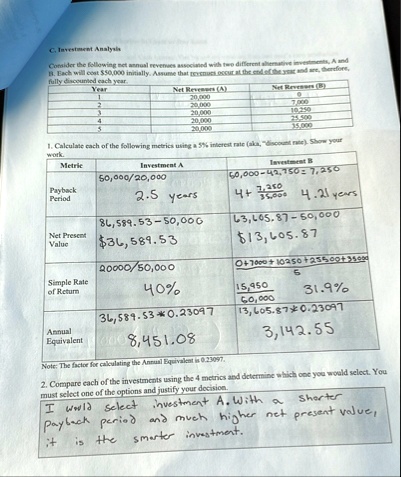
1. Calculate each of the following metrics using a 5% interest rate (aka, "discount rate). Show your
work.
Metric
Payback
Period
Investment A
$\frac{50,000}{20,000}$
Investment B
$\frac{50,000-42,750}{7,250}$
2. 5 years
$4+\frac{7,250}{35,000}$
4.21 years
86,589.53-50,000
Net Present
Value
$36,589.53
20000/50,000
63,605.87-50,000
$13,605.87
$\frac{0+7000+10250+25500+35000}{5}$
Simple Rate
of Return
40%
$\frac{15,950}{60,000}$
31.9%
36,589.53*0.23097
13,605.87*0.23097
Annual
Equivalent
8,451.08
Note: The factor for calculating the Annual Equivalent is 0.23097.
3,142.55
2. Compare each of the investments using the 4 metrics and determine which one you would select. You
must select one of the options and justify your decision.
I would select investment A. With a shorter
payback period and much higher net present value,
it is the smarter investment.